
TDD 实现 Spring DI 容器 (六) - Qualifier 支持
Qualifier
自定义 Qualifier 的依赖
-
注册组件时,可额外指定 Qualifier
-
注册组件时,可从类对象上提取 Qualifier
-
寻找依赖时,需同时满足类型与自定义 Qualifier 标注
-
支持默认 Qualifier——Named
将上面的功能点,细分为多个测试任务
归属于 ContextTest 上下文中的任务,分别有关于 TypeBinding 和 DependencyCheck 的任务:
TypeBinding 的任务:
1   @Nested
2   public class WithQualifier {
3       // TODO binding component with qualifier
4       // TODO binding component with qualifiers
5       // TODO throw illegal component if illegal qualifier
6   }
DependencyCheck 的任务:
1   @Nested
2   public class WithQualifier {
3       // TODO dependency missing if qualifier not match
4       // TODO check cyclic dependencies with qualifier
5   }
归属于 InjectionTest 上下文中的任务,分别有关于 ConstructorInjection、FieldInjection、MethodInjection 的任务:
分别都有如下的测试任务:
1   @Nested
2   class WithQualifier {
3       // TODO inject with qualifier
4       // TODO throw illegal component if illegal qualifier given to injection point
5   }
binding component with qualifier
component 分为两种情况,分别是:instance 和 component。
绑定 instance
先实现 instance 的情况,创建测试:
1   // TODO binding component with qualifier
2   @Test
3   public void should_bind_instance_with_qualifier() {
4       Component component = new Component() {
5       };
6       config.bind(Component.class, component, new NamedLiteral("ChosenOne"));
7
8       Context context = config.getContext();
9
10      Component chosenOne =
11              context.get(Context.Ref.of(Component.class, new NamedLiteral("ChosenOne"))).get();
12      assertSame(component, chosenOne);
13  }
需要新建 NamedLiteral
1   record NamedLiteral(String value) implements jakarta.inject.Named {
2       @Override
3       public Class<? extends Annotation> annotationType() {
4           return jakarta.inject.Named.class;
5       }
6   }
并且需要在 ContextConfig 中增加包含三个参数的 bind 方法
1   public <Type> void bind(Class<Type> type, Type instance, Annotation qualifier) {
2   }
在 Ref 中增加两个参数的 of 方法:
1   static <ComponentType> Ref<ComponentType> of(Class<ComponentType> component, Annotation qualifier) {
2       return null;
3   }
使得编译通过。
实现
目前,保存 providers 的 map 中的 key 只有 class,我们现在需要的是 type 和 qualifier 两个参数共同组合成的 key
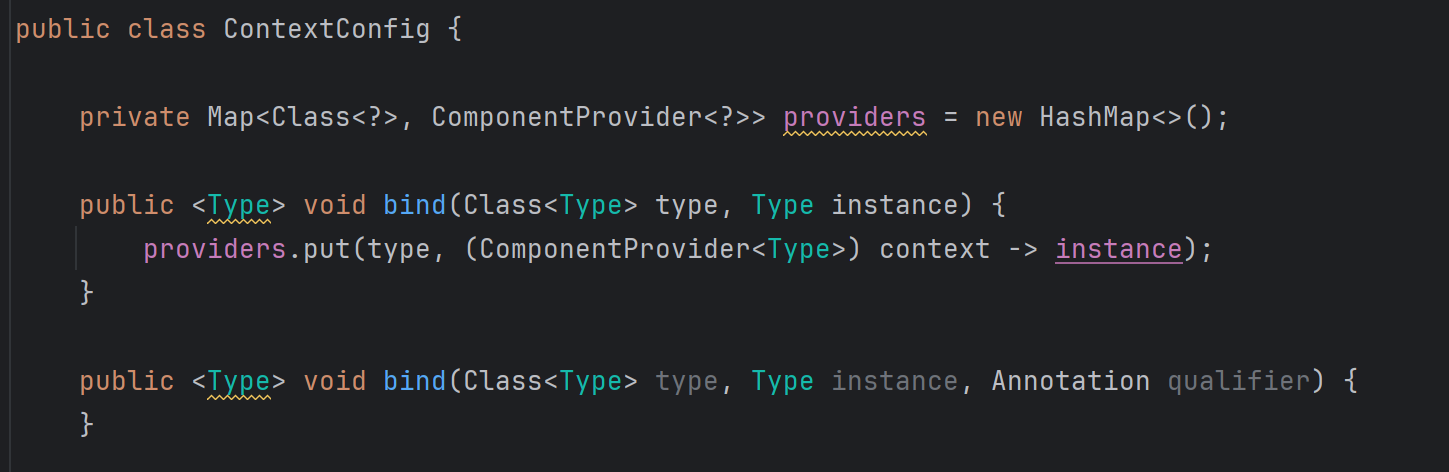
自定义一个 record 来封装 type 和 qualifier 的组合。
1   record Component(Class<?> type, Annotation qualifier) {
2   }
并新建一个 map 来保存
1 private Map<Component, ComponentProvider<?>> components = new HashMap<>();实现 bind 方法:
1   public <Type> void bind(Class<Type> type, Type instance, Annotation qualifier) {
2       components.put(new Component(type, qualifier), context -> instance);
3   }
get 时需要判断 Ref 中是否是 Qualifier 的情况
可以在在 Ref 中增加一个字段 qualifier ,并相应的在构造方法中增加字段:
1   private Annotation qualifier;
2
3   Ref(Type type, Annotation qualifier) {
4       init(type);
5       this.qualifier = qualifier;
6   }
7
8   public Annotation getQualifier() {
9       return qualifier;
10  }
新增分支,从 Context 中获取实例
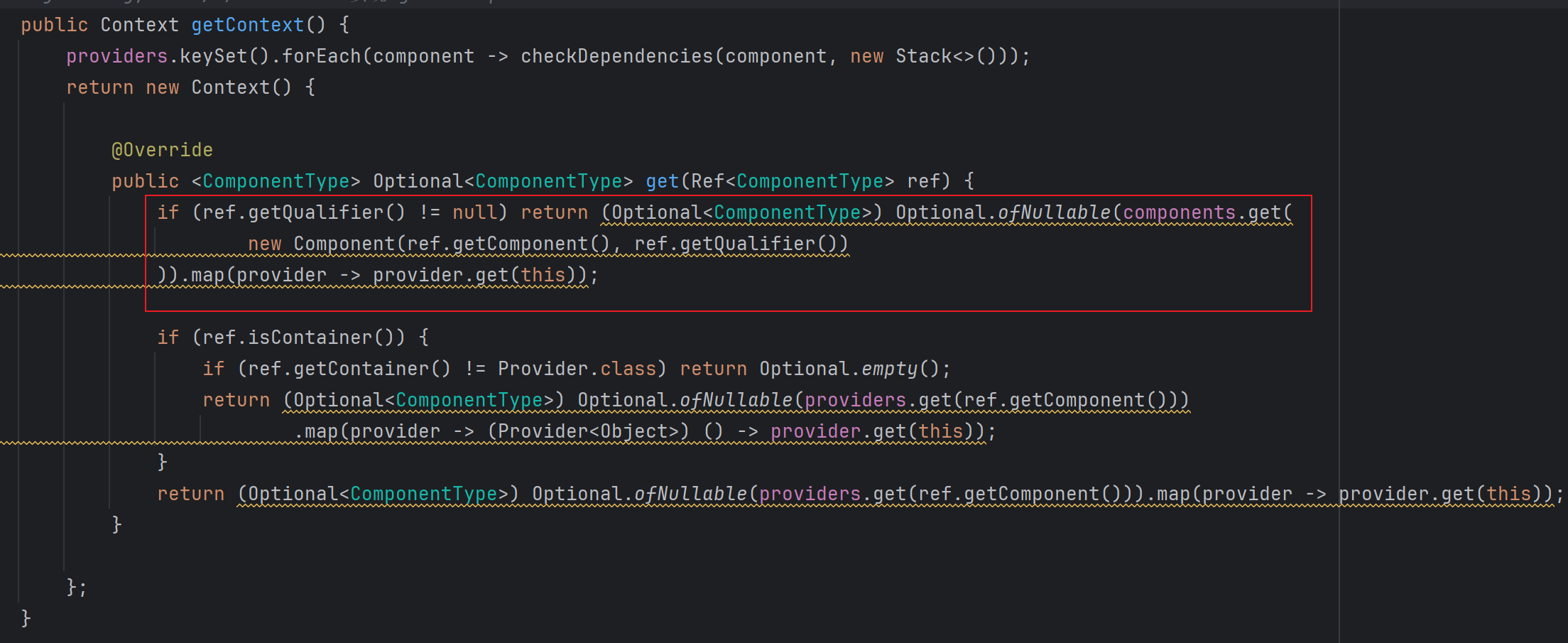
运行测试,通过。
绑定组件
构造测试
1   @Test
2   public void should_bind_component_with_qualifier() {
3       Dependency dependency = new Dependency() {
4       };
5       config.bind(Dependency.class, dependency);
6       config.bind(ConstructorInjection.class, ConstructorInjection.class, new NamedLiteral("ChosenOne"));
7
8       Context context = config.getContext();
9
10      ConstructorInjection chosenOne =
11              context.get(Context.Ref.of(ConstructorInjection.class, new NamedLiteral("ChosenOne"))).get();
12      assertSame(dependency, chosenOne.dependency());
13  }
1 static class ConstructorInjection implements Component {
2 private Dependency dependency;
3
4 @Inject
5 public ConstructorInjection(Dependency dependency) {
6 this.dependency = dependency;
7 }
8
9 @Override
10 public Dependency dependency() {
11 return dependency;
12 }
13 }需要增加一个对应的 bind 方法:
1   public <Type, Implementation extends Type>
2   void bind(Class<Type> type, Class<Implementation> implementation, Annotation qualifier) {
3       components.put(new Component(type, qualifier), new InjectionProvider(implementation));
4   }
运行测试,通过。
binding component with qualifiers
绑定、注册组件的时候,可以指定多个 qualifier,但是只能根据一个取,这是规范规定的。
绑定实例
1   // TODO binding component with qualifiers
2   @Test
3   public void should_bind_instance_with_multi_qualifiers() {
4       Component component = new Component() {
5       };
6       config.bind(Component.class, component, new NamedLiteral("ChosenOne"), new NamedLiteral("AnotherOne"));
7
8       Context context = config.getContext();
9
10      Component chosenOne = context.get(Context.Ref.of(Component.class, new NamedLiteral("ChosenOne"))).get();
11      Component anotherOne = context.get(Context.Ref.of(Component.class, new NamedLiteral("AnotherOne"))).get();
12
13      assertSame(component, anotherOne);
14      assertSame(chosenOne, anotherOne);
15  }
将 bind 方法的 qualifier 参数修改为可变数组,使编译通过:
1   public <Type> void bind(Class<Type> type, Type instance, Annotation... qualifiers) {
2       components.put(new Component(type, qualifiers[0]), context -> instance);
3   }
实现,bind 时分别注册每一 qualifier
1   public <Type> void bind(Class<Type> type, Type instance, Annotation... qualifiers) {
2       for (Annotation qualifier : qualifiers)
3           components.put(new Component(type, qualifier), context -> instance);
4   }
绑定组件
构造测试
1   @Test
2   public void should_bind_component_with_multi_qualifiers() {
3       Dependency dependency = new Dependency() {
4       };
5       config.bind(Dependency.class, dependency);
6       config.bind(ConstructorInjection.class, ConstructorInjection.class, new NamedLiteral("ChosenOne"),
7               new NamedLiteral("AnotherOne"));
8
9       Context context = config.getContext();
10
11      ConstructorInjection chosenOne =
12              context.get(Context.Ref.of(ConstructorInjection.class, new NamedLiteral("ChosenOne"))).get();
13       ConstructorInjection anotherOne =
14               context.get(Context.Ref.of(ConstructorInjection.class, new NamedLiteral("AnotherOne"))).get();
15
16      assertSame(dependency, chosenOne.dependency());
17      assertSame(dependency, anotherOne.dependency());
18  }
实现,对应的为 bind 方法的 qualifier 参数修改为可变数组,并分别注册每一个 qualifier :
1   public <Type, Implementation extends Type>
2   void bind(Class<Type> type, Class<Implementation> implementation, Annotation... qualifiers) {
3       for (Annotation qualifier : qualifiers)
4           components.put(new Component(type, qualifier), new InjectionProvider(implementation));
5   }
重构 ContextConfig 的内部实现
位置支持 Qualifier 我们目前已经有很多方法存在平行实现(实现方法非常类似),如果继续完成其他测试,那么会产生更多的平行实现。这里我们选择先重构。
components 替换掉 providers
接下来,就是要用 components 替换掉 providers
1   private Map<Class<?>, ComponentProvider<?>> providers = new HashMap<>();
2
3   private Map<Component, ComponentProvider<?>> components = new HashMap<>();
重构之前先看一下有哪些地方使用了 providers
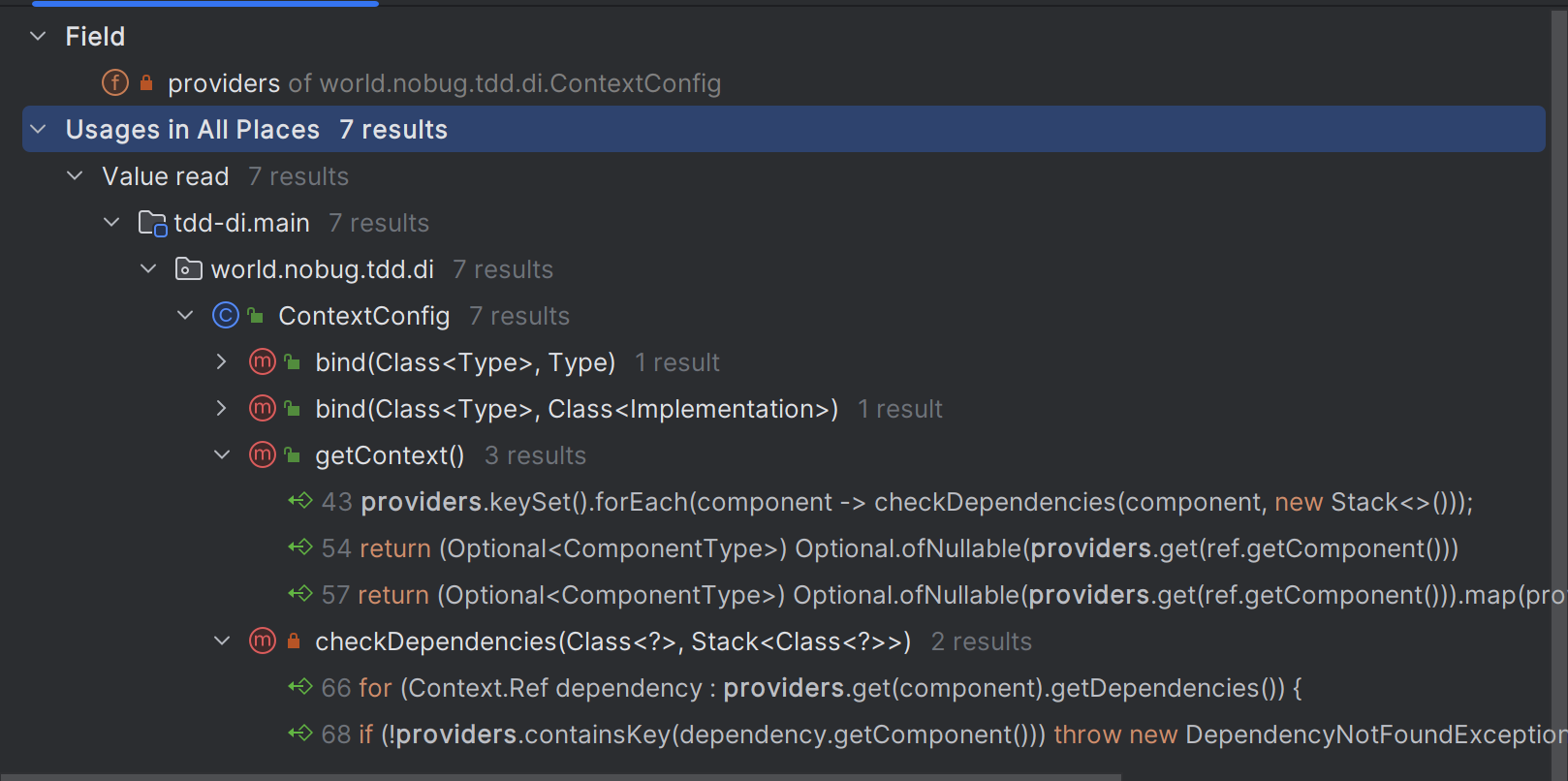
这里使用的主要地方是 getContext 和 checkDependencies。
先看 getContext
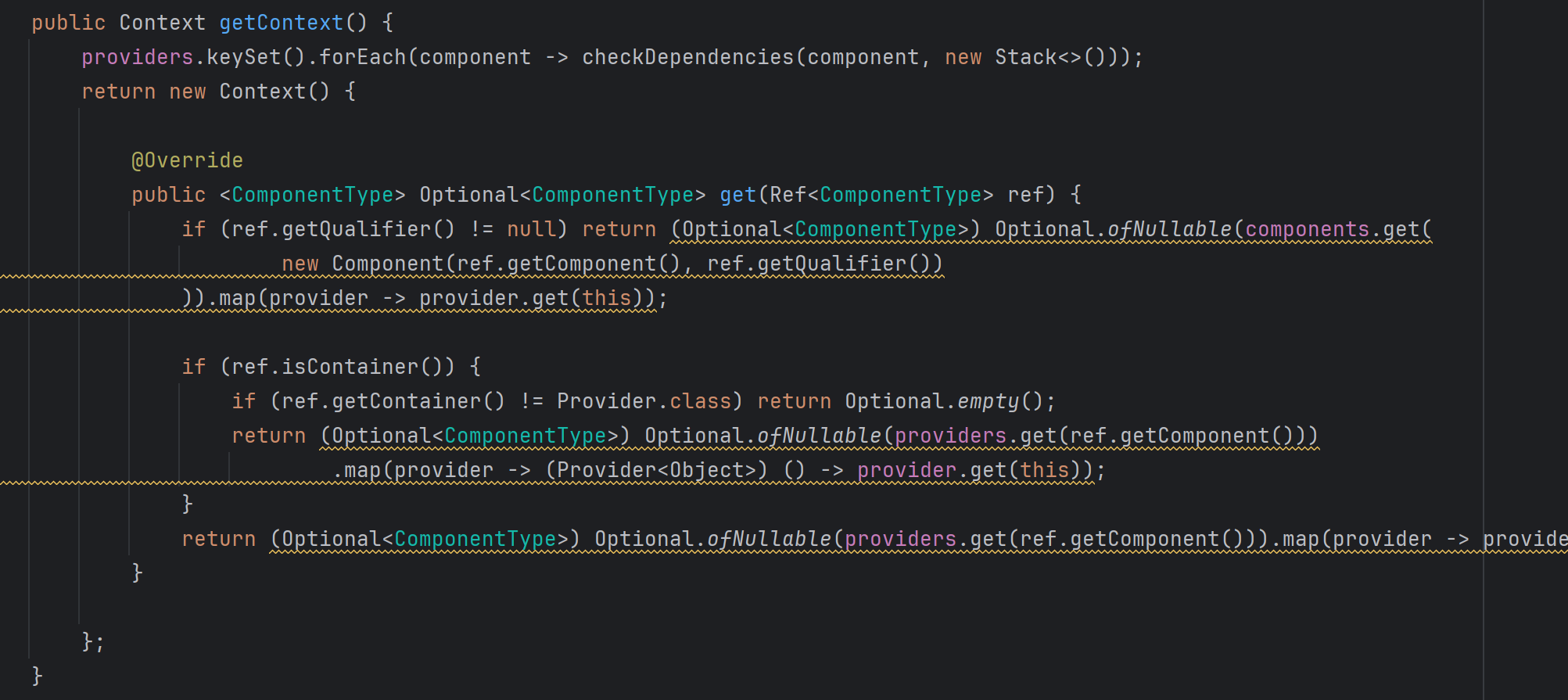
先将其中使用到 providers 的位置提取为方法:
1   private <ComponentType> ComponentProvider<?> getComponentProvider(Context.Ref<ComponentType> ref) {
2   //        components.get(new Component(ref.getComponent(), ref.getQualifier()));
3       return providers.get(ref.getComponent());
4   }
上面注释的代码,就是我们预期想要的实现。
逐步将使用到 providers 的地方用 components 替换掉。
bind 方法中替换:
1   public <Type> void bind(Class<Type> type, Type instance) {
2   //        providers.put(type, (ComponentProvider<Type>) context -> instance);
3       components.put(new Component(type, null), context -> instance);
4   }
5
6   public <Type, Implementation extends Type>
7   void bind(Class<Type> type, Class<Implementation> implementation) {
8   //        providers.put(type, new InjectionProvider(implementation));
9       components.put(new Component(type, null), new InjectionProvider(implementation));
10  }
getContext 方法替换:
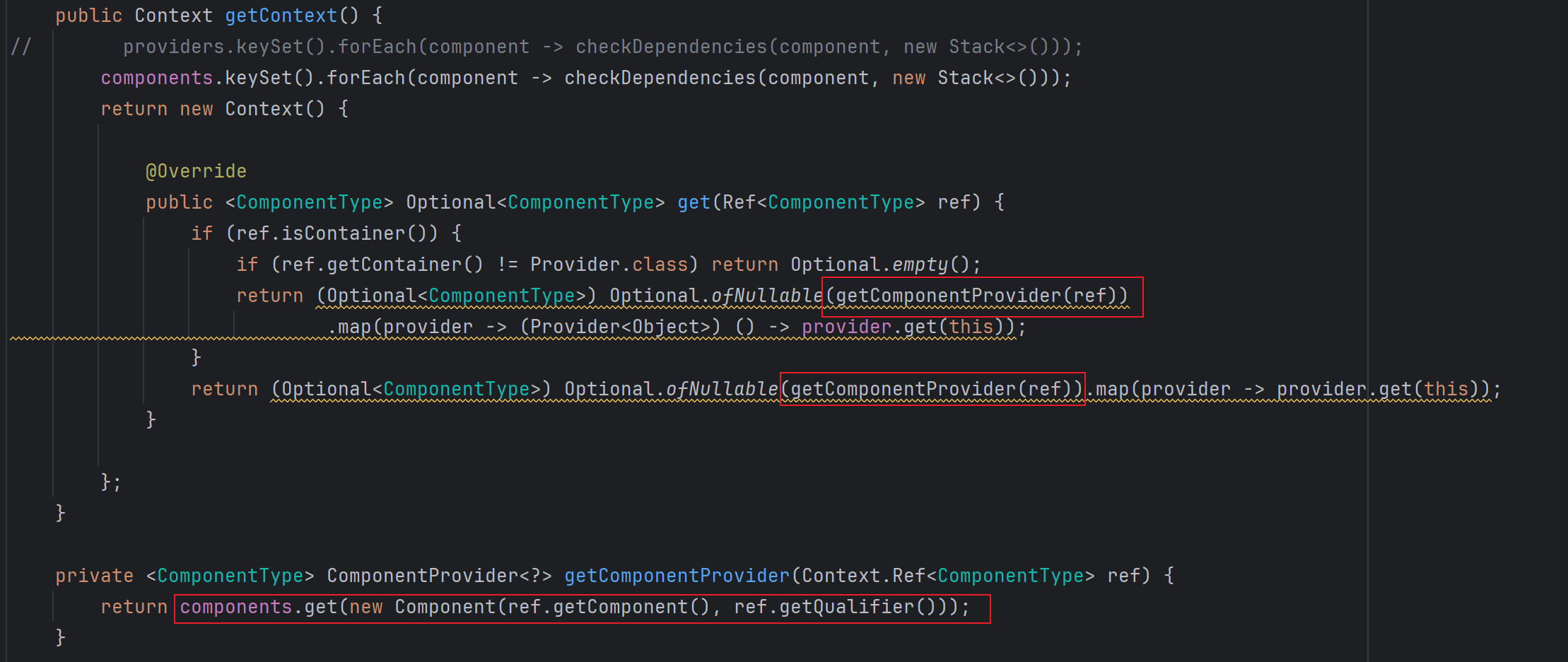
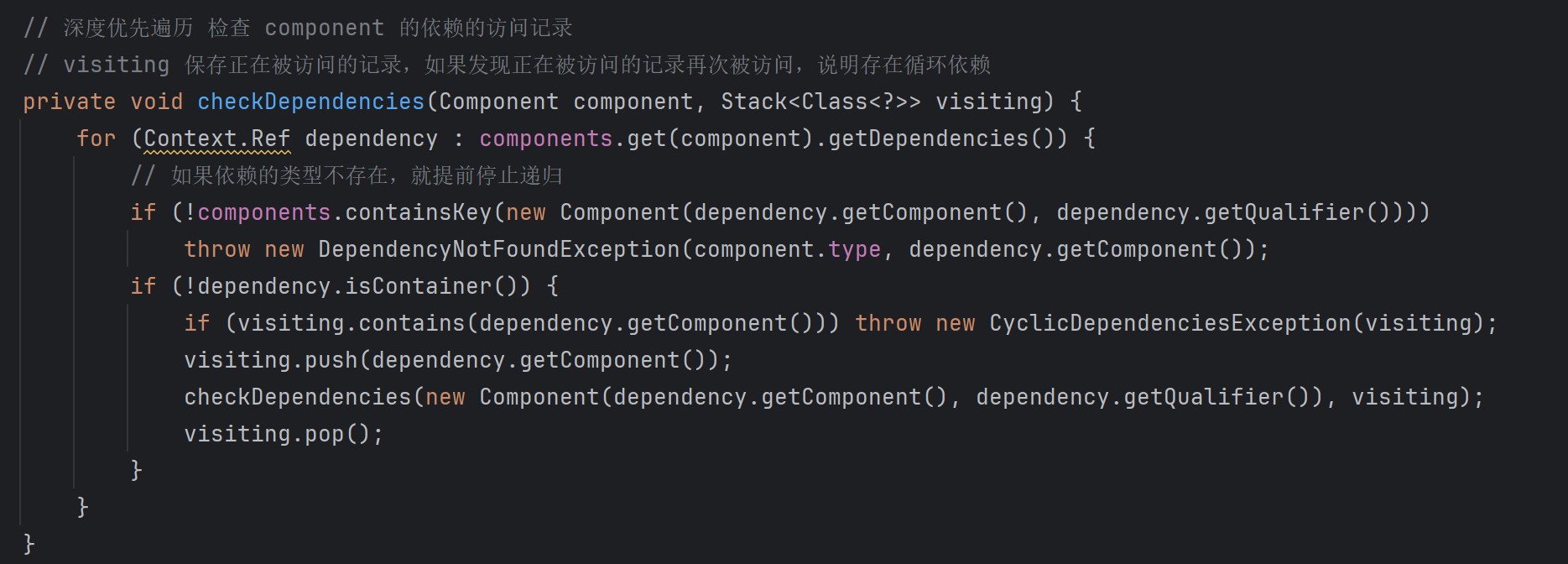
至此移除不在使用的 providers 即可。
观察以下两个 bind 方法,可以合并成一个
1   public <Type> void bind(Class<Type> type, Type instance) {
2       components.put(new Component(type, null), context -> instance);
3   }
4
5   public <Type> void bind(Class<Type> type, Type instance, Annotation... qualifiers) {
6       for (Annotation qualifier : qualifiers)
7           components.put(new Component(type, qualifier), context -> instance);
8   }
合并后为:
1 public <Type> void bind(Class<Type> type, Type instance, Annotation... qualifiers) { 2 if (qualifiers.length == 0) components.put(new Component(type, null), context -> instance); 3 for (Annotation qualifier : qualifiers) 4 components.put(new Component(type, qualifier), context -> instance); 5 }建议不合并,减少一个 if 也可以有一个更清晰的对外接口。
其他坏味道
可以观察到,很多使用 Ref 的地方都需要转换为 Component
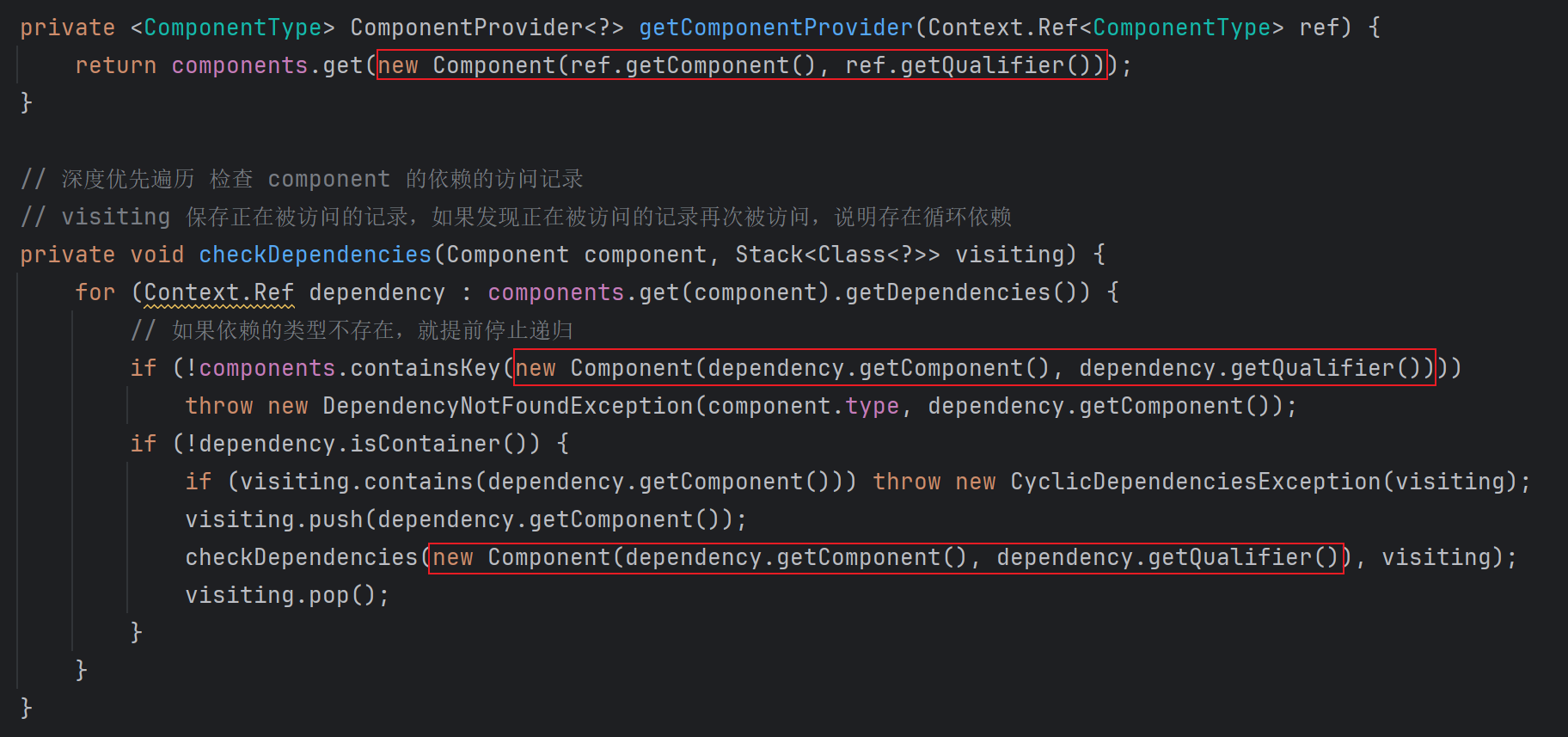
好像 Ref 和 Component 之间存在某种关系。
其实,Ref 就应该将 Class 和 Qualifier 封装为一个整体,而不是再将这两个拆散。
一个更合理的实现是,使用一个 Component 来替换掉 Class<?> component 和 Annotation qualifier 字段:
1   class Ref<ComponentType> {
2       private Type container;
3   //        private ContextConfig.Component component;
4       private Class<?> component;
5       private Annotation qualifier;
6   }
这里先将 Ref 重名为 ComponentRef,并从 Context 中移出,作为一个外部类。
也将 Component 从 ContextConfig 中移出,作为一个外部类。
由于原来已经有一个 Component 用于作为测试用例的类,这里先将原来的 Component 修改为 TestComponent,以避免因重名造成的异常。
在 ComponentRef 中增加 component 字段,并将原来的 component 字段重命名为 componentType:
1   public class ComponentRef<ComponentType> {
2       private Type container;
3       private Component component;
4       private Class<?> componentType;
5       private Annotation qualifier;
6   }
增加一个 component 字段,相应的给 init 中增加一个 qualifier 的参数,并在其中为 component 赋值。
1   private void init(Type type, Annotation qualifier) {
2       if (type instanceof ParameterizedType) {
3           this.container = ((ParameterizedType) type).getRawType();
4           this.componentType = (Class<?>) ((ParameterizedType) type).getActualTypeArguments()[0];
5           this.component = new Component(componentType, qualifier);
6       } else {
7           this.componentType = (Class<?>) type;
8           this.component = new Component(componentType, qualifier);
9       }
10  }
那么所有之前通过 ref 来 new Component 都可以替换为 ref.component().
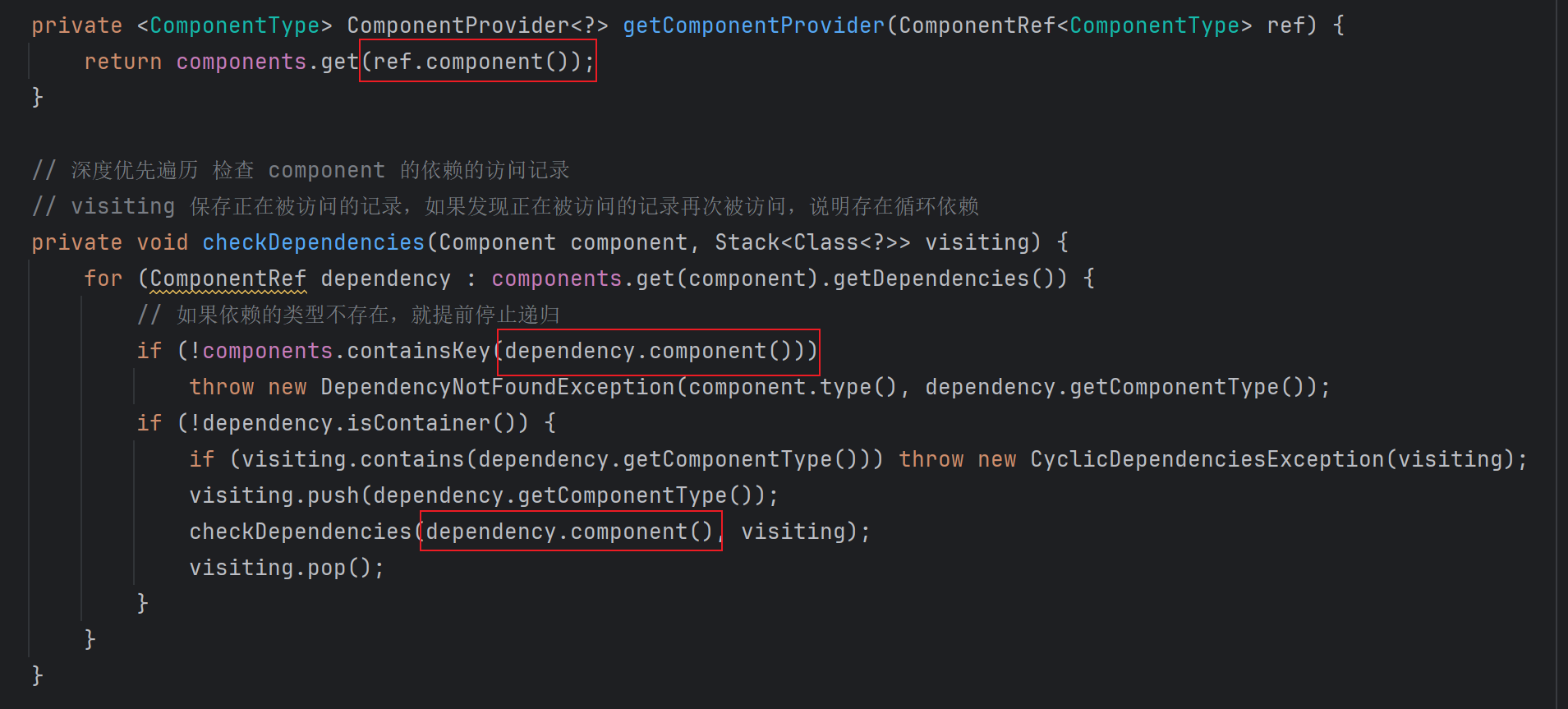
还可以发现,getQualifier 已无处使用,可以移除,qualifier 字段也无处使用,可以移除。
同时也可将 getComponentType 的实现替换为如下:
1   public Class<?> getComponentType() {
2       return component.type();
3   }
接着,期望移除 component,先找到 component 在哪里被使用。
一个地方是在 equals 和 hashCode 方法中被使用,先重新生成这两个方法,新生成的方法不要使用 componentType 字段。
其他使用的地方就是在 init 方法中,修改 init 方法为:
1   private void init(Type type, Annotation qualifier) {
2       if (type instanceof ParameterizedType) {
3           this.container = ((ParameterizedType) type).getRawType();
4           Class<?> componentType = (Class<?>) ((ParameterizedType) type).getActualTypeArguments()[0];
5           this.component = new Component(componentType, qualifier);
6       } else {
7           this.component = new Component((Class<?>) type, qualifier);
8       }
9   }
移除 componentType 字段。
重构测试
测试文档化
从测试文档化的角度来讲,下面的两个测试是不需要的。
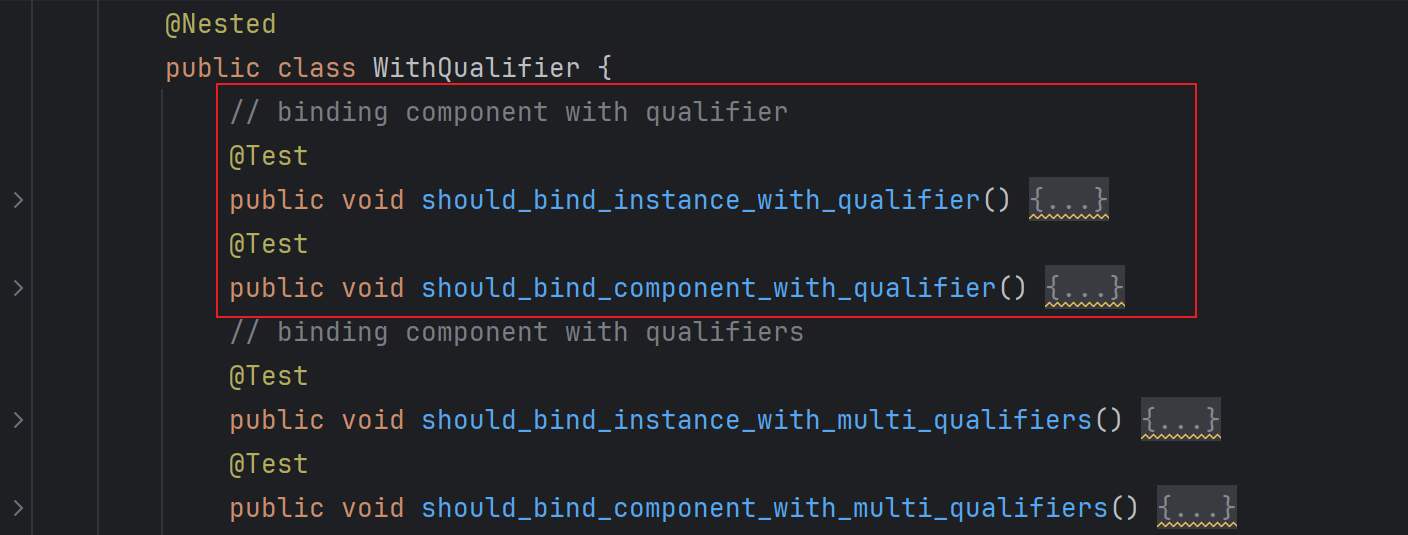
这两个测试,是驱动我们开发的记录,但是不应该作为最终的文档形式。
自定义 Qualifier
1   @java.lang.annotation.Documented
2   @java.lang.annotation.Retention(RUNTIME)
3   @jakarta.inject.Qualifier
4   @interface AnotherOne {
5   }
6
7   record AnotherOneLiteral() implements AnotherOne {
8       @Override
9       public Class<? extends Annotation> annotationType() {
10          return AnotherOne.class;
11      }
12  }
bind 时使用自定义注解:
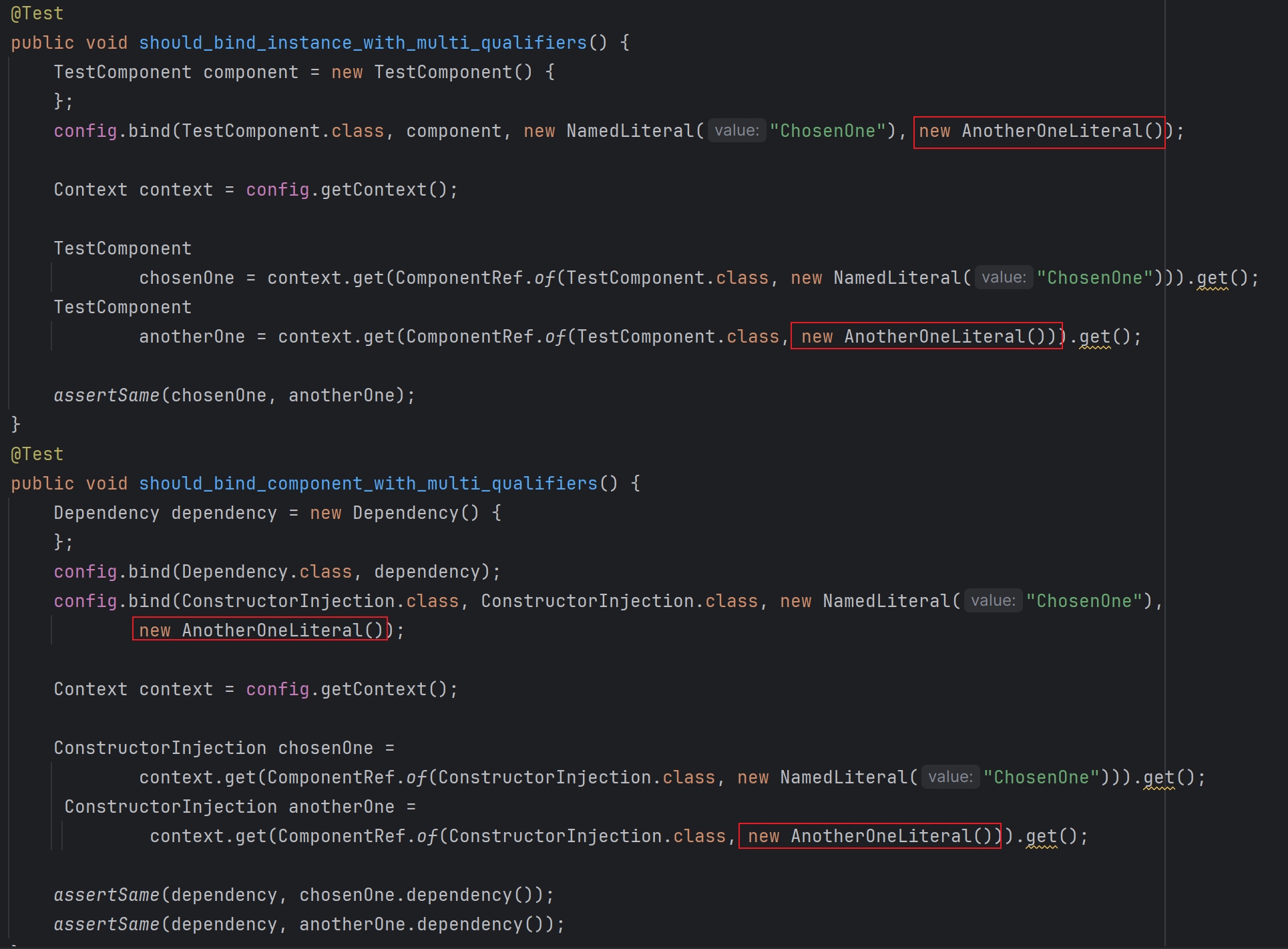
非法的 Qualifier
验证的是非 Qualifier 注解标记的情况。
需要先创建一个非 Qualifier 的注解的包装
1   record TestLiteral() implements Test {
2       @Override
3       public Class<? extends Annotation> annotationType() {
4           return Test.class;
5       }
6 }- 构造绑定实例的测试:
1   // TODO throw illegal component if illegal qualifier
2   @Test
3   public void should_throw_exception_if_illegal_qualifier_given_to_instance() {
4       TestComponent component = new TestComponent() {
5       };
6       assertThrows(IllegalComponentException.class, () -> config.bind(TestComponent.class, component, new TestLiteral()));
7   }
实现,绑定时检查是否包含非Qualifier的注解:
1   public <Type> void bind(Class<Type> type, Type instance, Annotation... qualifiers) {
2       if (Arrays.stream(qualifiers).anyMatch(q -> !q.annotationType().isAnnotationPresent(Qualifier.class)))
3           throw new IllegalComponentException();
4       for (Annotation qualifier : qualifiers)
5           components.put(new Component(type, qualifier), context -> instance);
6 }- 构造绑定组件的测试:
1   @Test
2   public void should_throw_exception_if_illegal_qualifier_given_to_component() {
3       assertThrows(IllegalComponentException.class,
4               () -> config.bind(ConstructorInjection.class, ConstructorInjection.class, new TestLiteral()));
5   }
实现,同样的绑定时检查是否包含非Qualifier的注解:
1   public <Type, Implementation extends Type>
2   void bind(Class<Type> type, Class<Implementation> implementation, Annotation... qualifiers) {
3       if (Arrays.stream(qualifiers).anyMatch(q -> !q.annotationType().isAnnotationPresent(Qualifier.class)))
4           throw new IllegalComponentException();
5       for (Annotation qualifier : qualifiers)
6           components.put(new Component(type, qualifier), new InjectionProvider(implementation));
7   }
依赖检查
Qualifier 标记的依赖不存在
测试指定了 Qualifier 的依赖的情况:
如果依赖的参数被 Qualifier 标记,那么从 容器中获取的依赖也必须被 Qualifier 标记,否则也要抛出 DependencyNotFoundException 异常。
1   // TODO dependency missing if qualifier not match
2   @Test
3   public void should_throw_exception_if_dependency_not_found_with_qualifier() {
4
5       config.bind(Dependency.class, new Dependency() {
6       });
7       config.bind(InjectConstructor.class, InjectConstructor.class);
8
9       assertThrows(DependencyNotFoundException.class, () -> config.getContext());
10
11  }
12
13  static class InjectConstructor {
14      @Inject
15      public InjectConstructor(@AnotherOne Dependency dependency) {
16      }
17  }
目前的依赖检查的实现是基于 CompronentProvider 中的 getDependencies 方法。
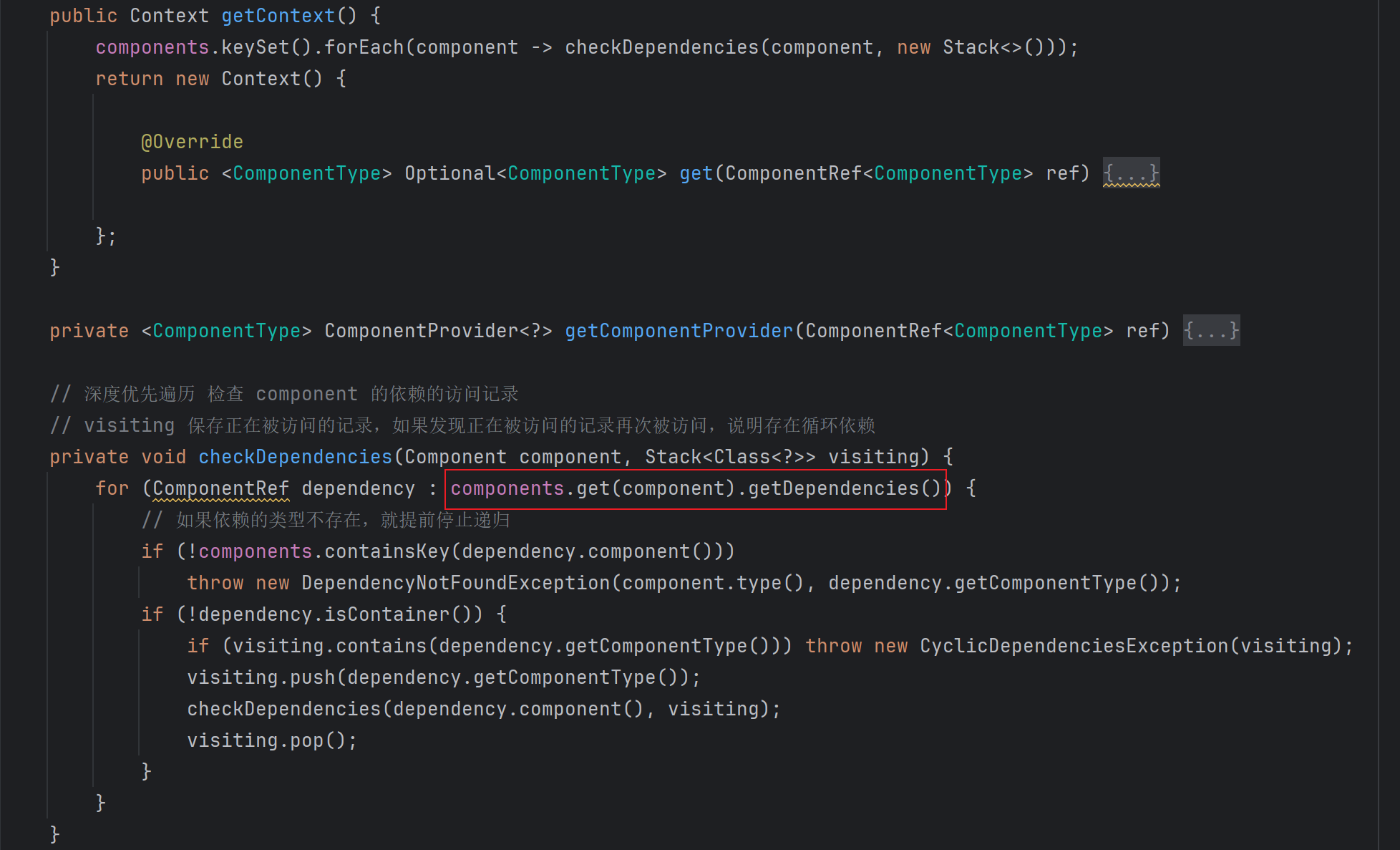
但是目前获取依赖时并没有区分被 Qualifier 标记的情况。所以想要实现依赖缺失的检查还需要修改 CompronentProvider 中的 getDependencies 方法。
这样就衍生出,include qualifier with dependency 的测试。这属于 InjectionTest 测试上下文的范畴。
分别在 InjectionTest 的 ConstructorInjection、FieldInjection、MethodInjection 中的 WithQualifier 测试分组中增加任务:
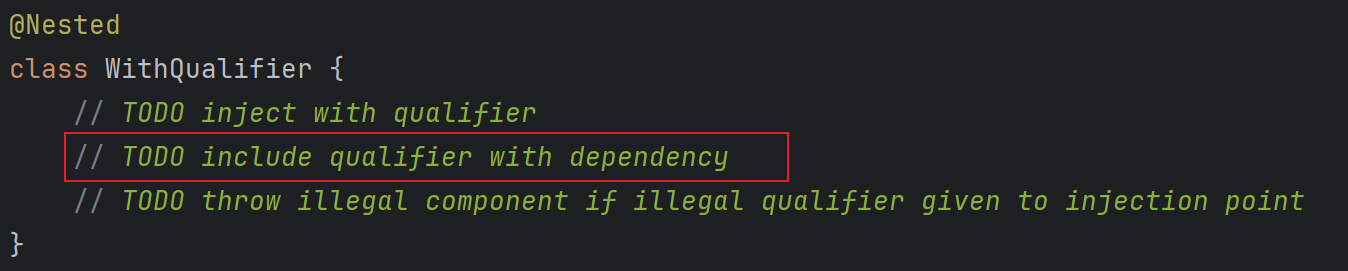
构造函数注入被 Qualifier 标注的测试:
1   // TODO include qualifier with dependency
2   static class InjectConstructor {
3       @Inject
4       public InjectConstructor(@Named("ChosenOne") Dependency dependency) {
5       }
6   }
7   @Test
8   public void should_include_qualifier_with_dependency() {
9       InjectionProvider<InjectConstructor> provider = new InjectionProvider<>(InjectConstructor.class);
10
11      assertArrayEquals(new ComponentRef[]{ComponentRef.of(Dependency.class, new NamedLiteral("ChosenOne"))},
12              provider.getDependencies().toArray(ComponentRef[]::new));
13  }
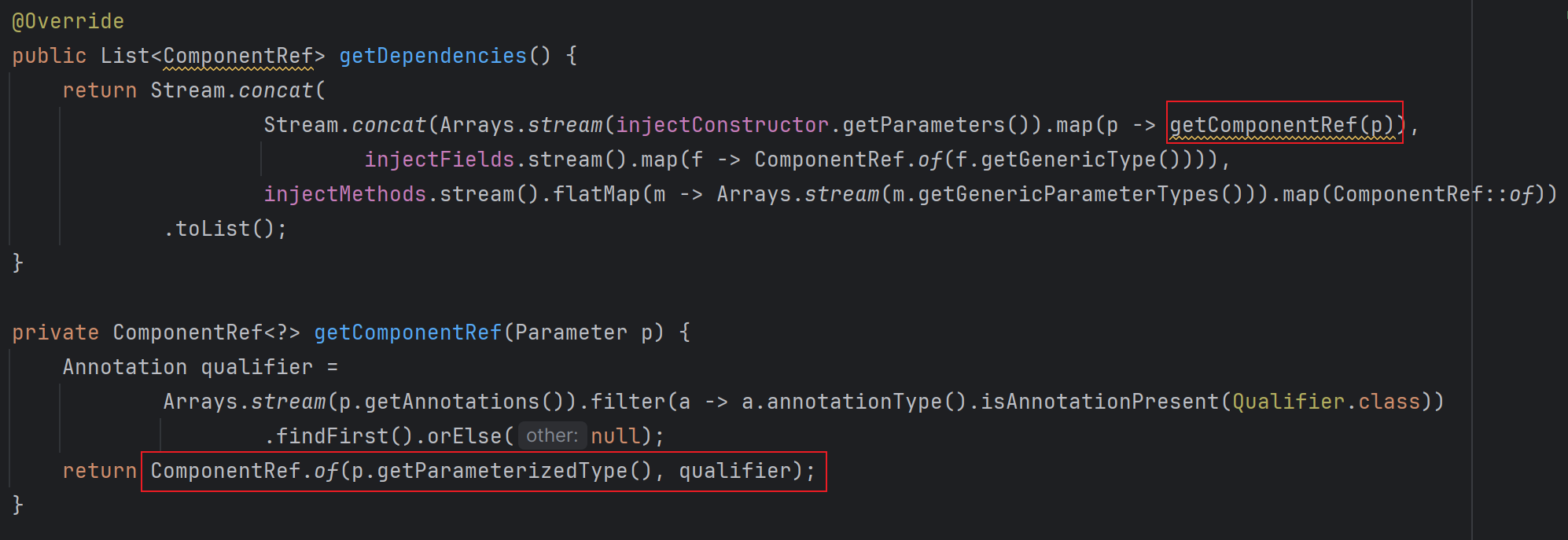
实现,需要修改以下代码:
1   @Override
2   public List<ComponentRef> getDependencies() {
3       return Stream.concat(
4                       Stream.concat(Arrays.stream(injectConstructor.getParameters()).map(Parameter::getParameterizedType),
5                               injectFields.stream().map(Field::getGenericType)),
6                       injectMethods.stream().flatMap(m -> Arrays.stream(m.getGenericParameterTypes())))
7               .map(ComponentRef::of).toList();
8   }
目前并没有考虑标注的情况。
修改 Provider 中的实现,获取依赖时在返回的 ComponentRef 应包含注解的信息。
此外,判断 Named 于 NamedLiteral 是否相等,还需要修改 NamedLiteral 中的 equals 方法,因为是测试,所以只需要一个简单的实现。
如果是生产代码中,应该根据 Annotation 中规范的方式编写。
1   @Override
2   public boolean equals(Object o) {
3       if (o instanceof jakarta.inject.Named named) return value.equals(named.value());
4       return false;
5   }
运行测试通过。
同时,should_throw_exception_if_dependency_not_found_with_qualifier 测试也将通过。
DependencyNotFoundException 信息优化
目前 DependencyNotFoundException 中并不包含 Qualifier 注解的信息。
1   public class DependencyNotFoundException extends RuntimeException {
2       private Class<?> dependency;
3       private Class<?> component;
4
5       public DependencyNotFoundException(Class<?> component, Class<?> dependency) {
6           this.dependency = dependency;
7           this.component = component;
8       }
9
10      public Class<?> getDependency() {
11          return dependency;
12      }
13
14      public Class<?> getComponent() {
15          return component;
16      }
17  }
如果我们还需要知道异常中注解的信息,可以修改测试,增加如下校验:
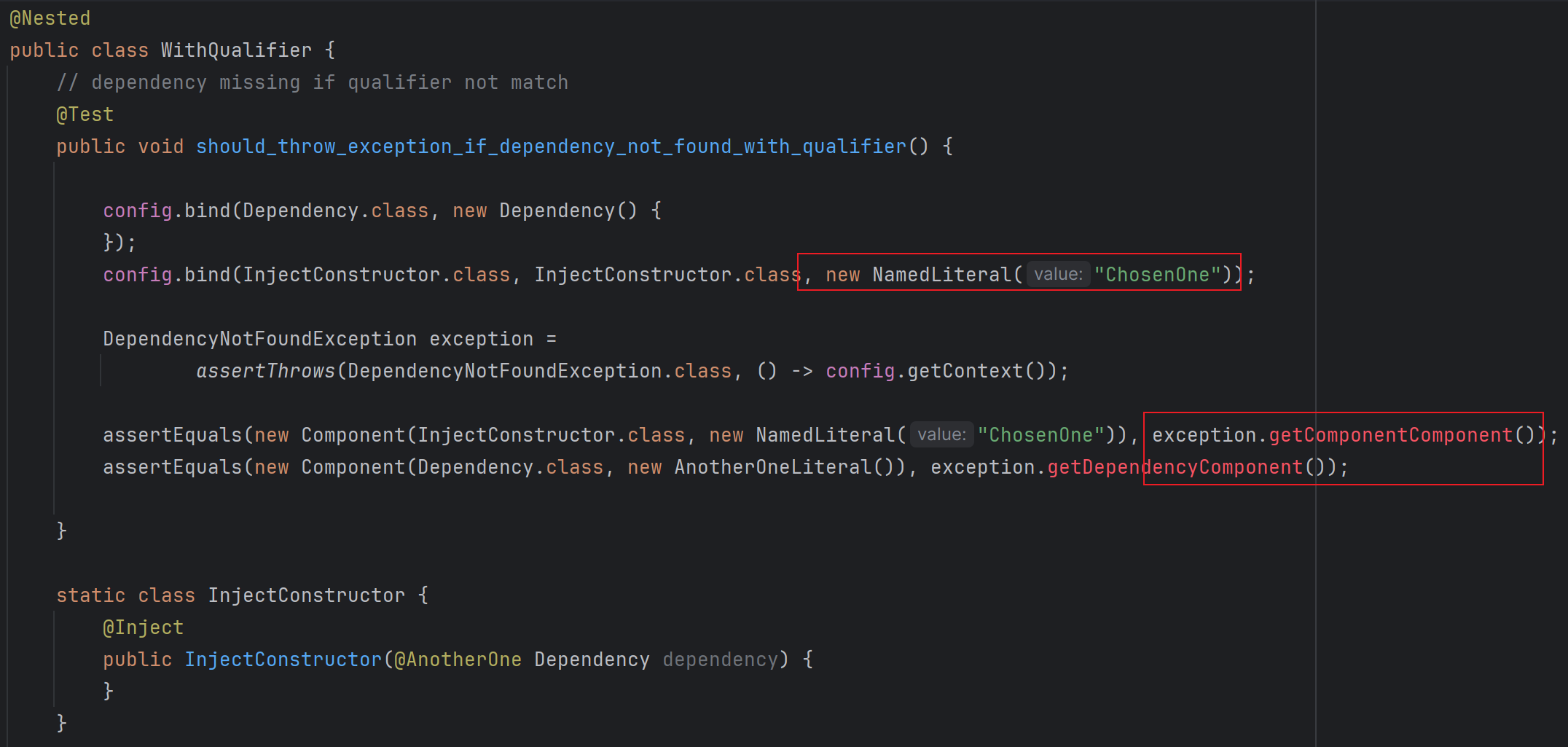
在 DependencyNotFoundException 中新建两个方法,分别用于获取造成异常的 component 和 dependency 的信息。
DependencyNotFoundException 重构为:
增加两个 Component 类型的字段和对应的 getter,以及构造函数。
1   public class DependencyNotFoundException extends RuntimeException {
2       private Class<?> dependency;
3       private Class<?> component;
4       private Component dependencyComponent;
5       private Component componentComponent;
6
7       public DependencyNotFoundException(Class<?> component, Class<?> dependency) {
8           this.dependency = dependency;
9           this.component = component;
10      }
11
12      public DependencyNotFoundException(Component componentComponent, Component dependencyComponent) {
13          this.dependencyComponent = dependencyComponent;
14          this.componentComponent = componentComponent;
15      }
16
17      public Class<?> getDependency() {
18          return dependency;
19      }
20
21      public Class<?> getComponent() {
22          return component;
23      }
24
25      public Component getDependencyComponent() {
26          return this.dependencyComponent;
27      }
28
29      public Component getComponentComponent() {
30          return this.componentComponent;
31      }
32  }
同样的 AnotherOneLiteral 也需要实现 equals 方法,否则 AnotherOneLiteral 和 AnotherOne 的比较会异常
1   record AnotherOneLiteral() implements AnotherOne {
2       @Override
3       public Class<? extends Annotation> annotationType() {
4           return AnotherOne.class;
5       }
6
7       @Override
8       public boolean equals(Object o) {
9           return o instanceof AnotherOne;
10      }
11  }
实现,找到唯一会创建 DependencyNotFoundException 的地方是 ContextConfig 中的 checkDependencies 方法,修改为:
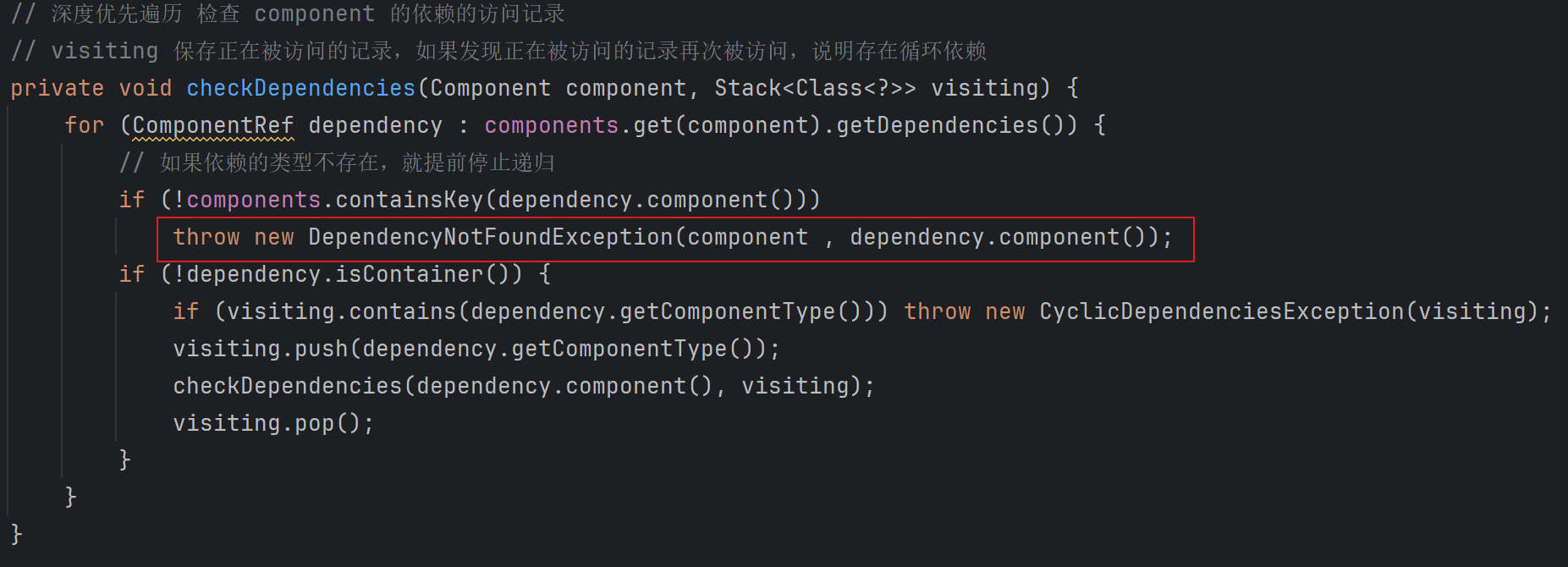
运行测试,should_throw_exception_if_dependency_not_found_with_qualifier 将通过。
但是,因为修改了返回的 DependencyNotFoundException 中的信息,所以之前创建的检查依赖缺失的测试将失败:
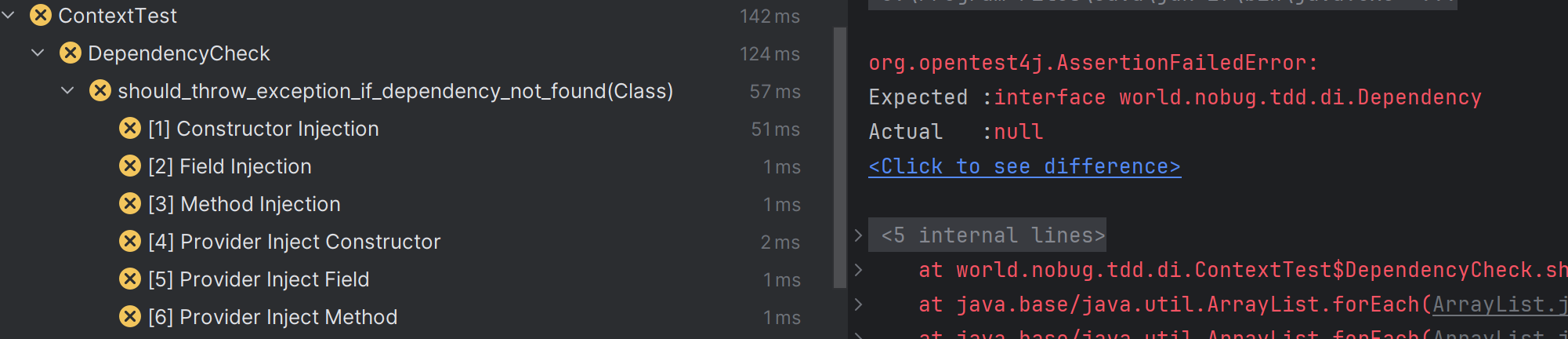
因为当前异常中的 dependency 和 component 并没有被赋值:
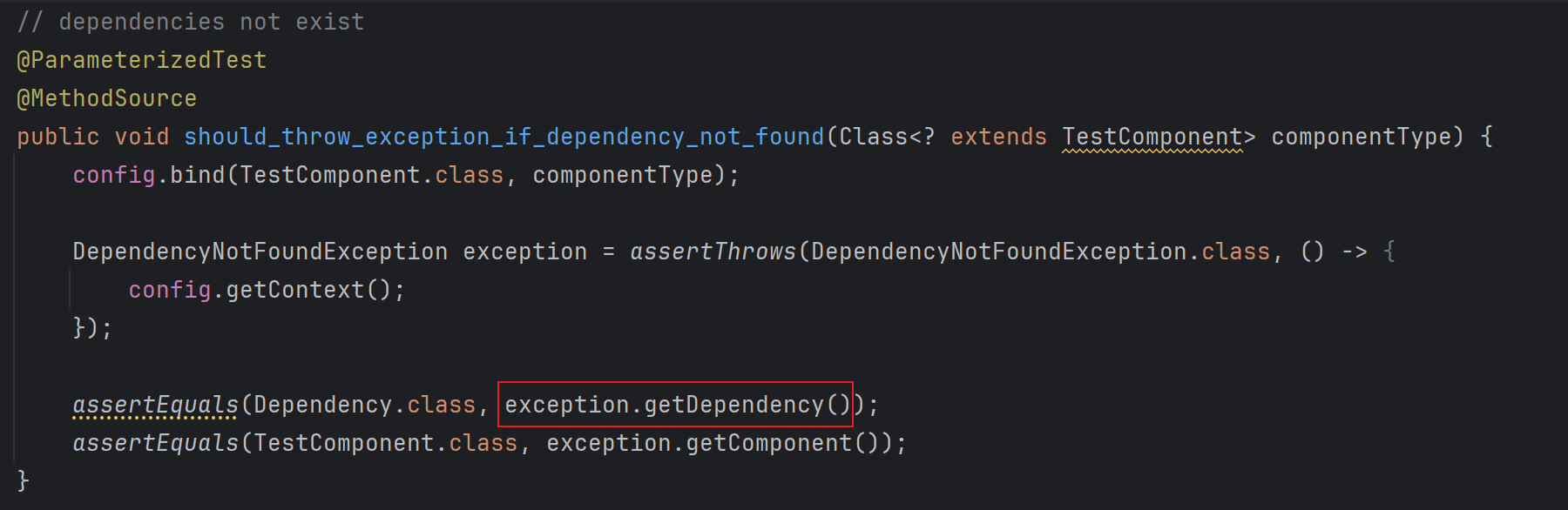
修改 DependencyNotFoundException 方法返回的信息:
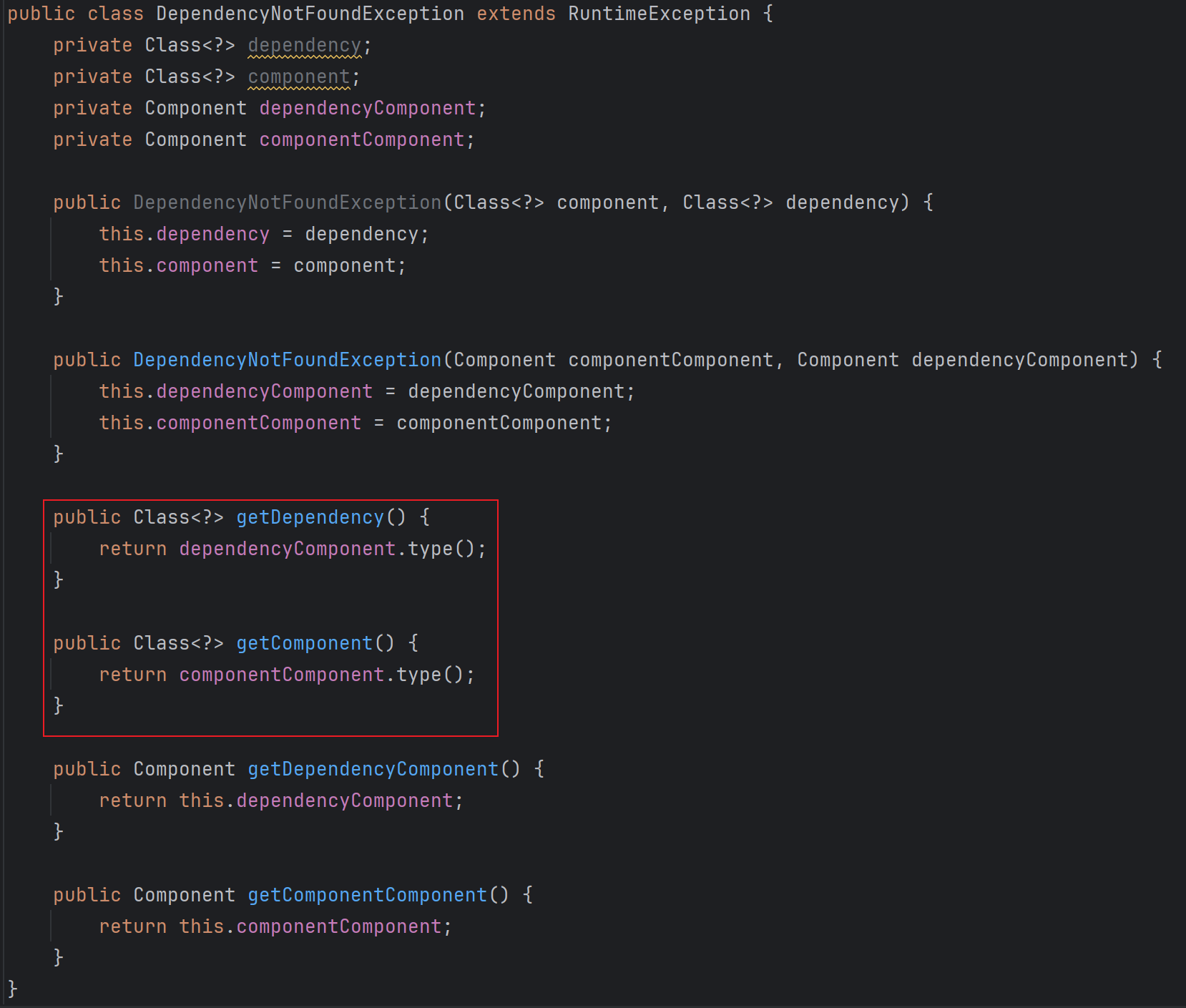
删除未使用的字段的构造函数。
更进一步,将使用 getDependency 和 getComponent 方法的地方,替换为使用 getDependencyComponent 和 getComponentComponent:
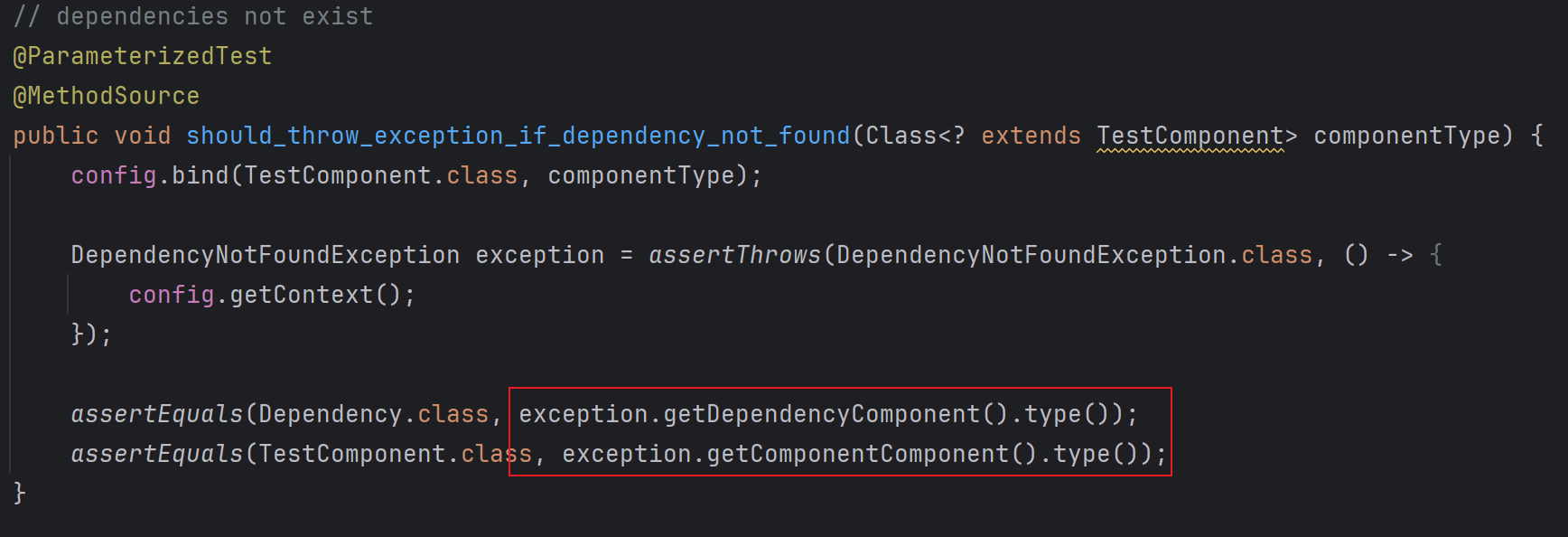
至此,就没有地方使用 getDependency 和 getComponent 方法。可移除,移除后可以对 DependencyNotFoundException 中的字段和方法进行重命名。
最终,DependencyNotFoundException 重构为:
1   public class DependencyNotFoundException extends RuntimeException {
2       private Component dependency;
3       private Component component;
4
5       public DependencyNotFoundException(Component component, Component dependency) {
6           this.dependency = dependency;
7           this.component = component;
8       }
9
10      public Component getDependency() {
11          return this.dependency;
12      }
13
14      public Component getComponent() {
15          return this.component;
16      }
17  }
循环依赖
构造测试:
我们期望: A -> @AnotherOne A -> @Named A 不构成循环依赖,因为 Qualifier + 类型 的组合构造类型的key
1   // TODO check cyclic dependencies with qualifier
2   // A -> @AnotherOne A -> @Named A
3   static class AnotherOneDependency implements Dependency {
4       @Inject
5       public AnotherOneDependency(@jakarta.inject.Named("ChosenOne") Dependency dependency) {
6       }
7   }
8   static class NotCyclicDependency implements Dependency {
9       @Inject
10      public NotCyclicDependency(@AnotherOne Dependency dependency) {
11      }
12  }
13  @Test
14  public void should_not_throw_exception_if_component_with_same_type_tagged_with_different_qualifier() {
15      Dependency instance = new Dependency() {
16      };
17      config.bind(Dependency.class, instance, new NamedLiteral("ChosenOne"));
18      config.bind(Dependency.class, AnotherOneDependency.class, new AnotherOneLiteral());
19      config.bind(Dependency.class, NotCyclicDependency.class);
20
21      assertDoesNotThrow(() -> config.getContext());
22  }
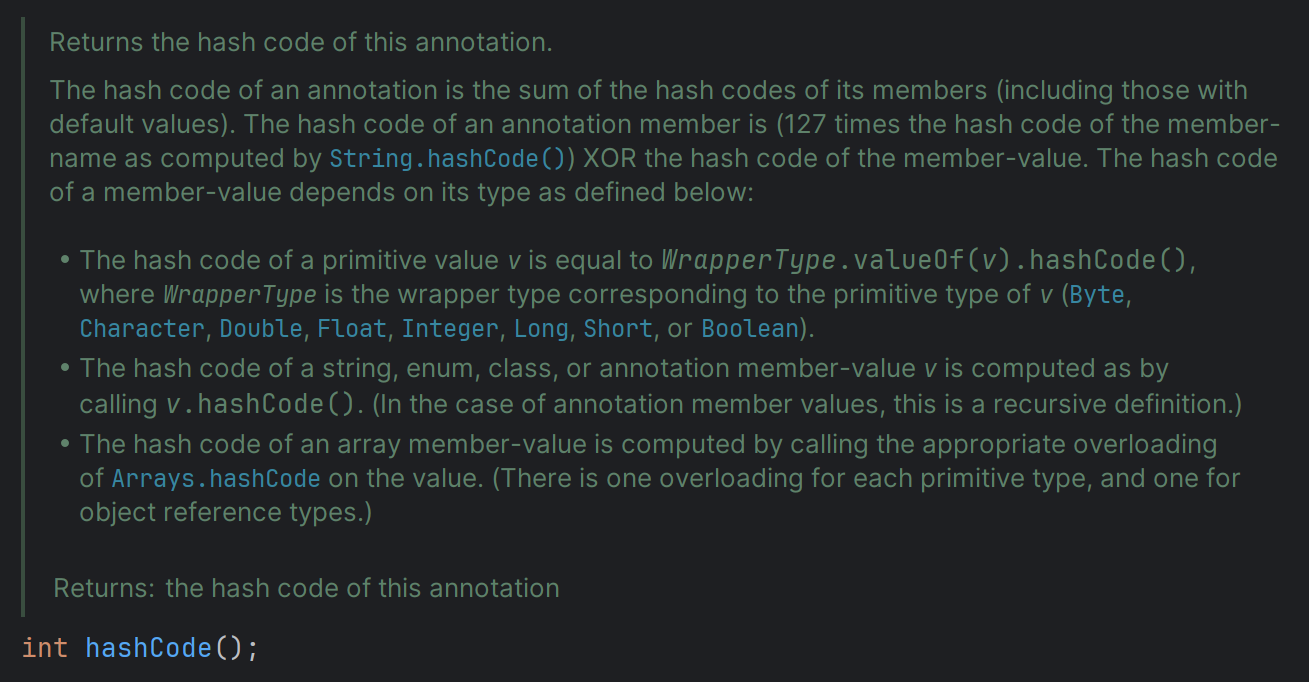
这里还需要为 NamedLiteral 创建 hashCode 方法:
1   record NamedLiteral(String value) implements jakarta.inject.Named {
2       @Override
3       public Class<? extends Annotation> annotationType() {
4           return jakarta.inject.Named.class;
5       }
6
7       @Override
8       public boolean equals(Object o) {
9           if (o instanceof jakarta.inject.Named named) return value.equals(named.value());
10          return false;
11      }
12
13      @Override
14      public int hashCode() {
15          return "value".hashCode() * 127 ^ value.hashCode();
16      }
17  }
hashCode 方法需要根据 Annotation 的规范创建:
运行测试,将抛出 CyclicDependenciesException
找到抛出 CyclicDependenciesException 的代码,目前只有 ContextConfig 中的 checkDependencies 方法会抛出 CyclicDependenciesException
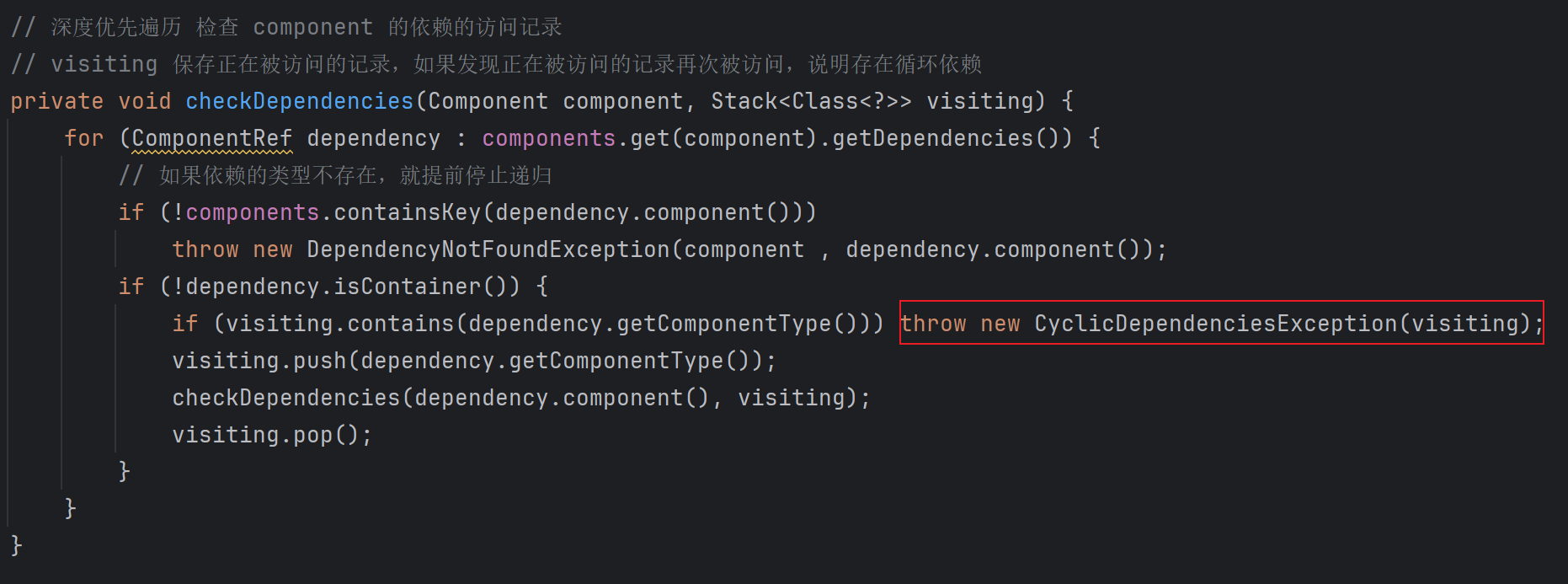
原因是 visiting 栈中只包含 Class 的信息,没有 Qualifier 注解相关的信息。
那么需要把 Stack 中的类型由 Class<?> 改为 Component,并将使用 visiting 的地方都改为 Component:
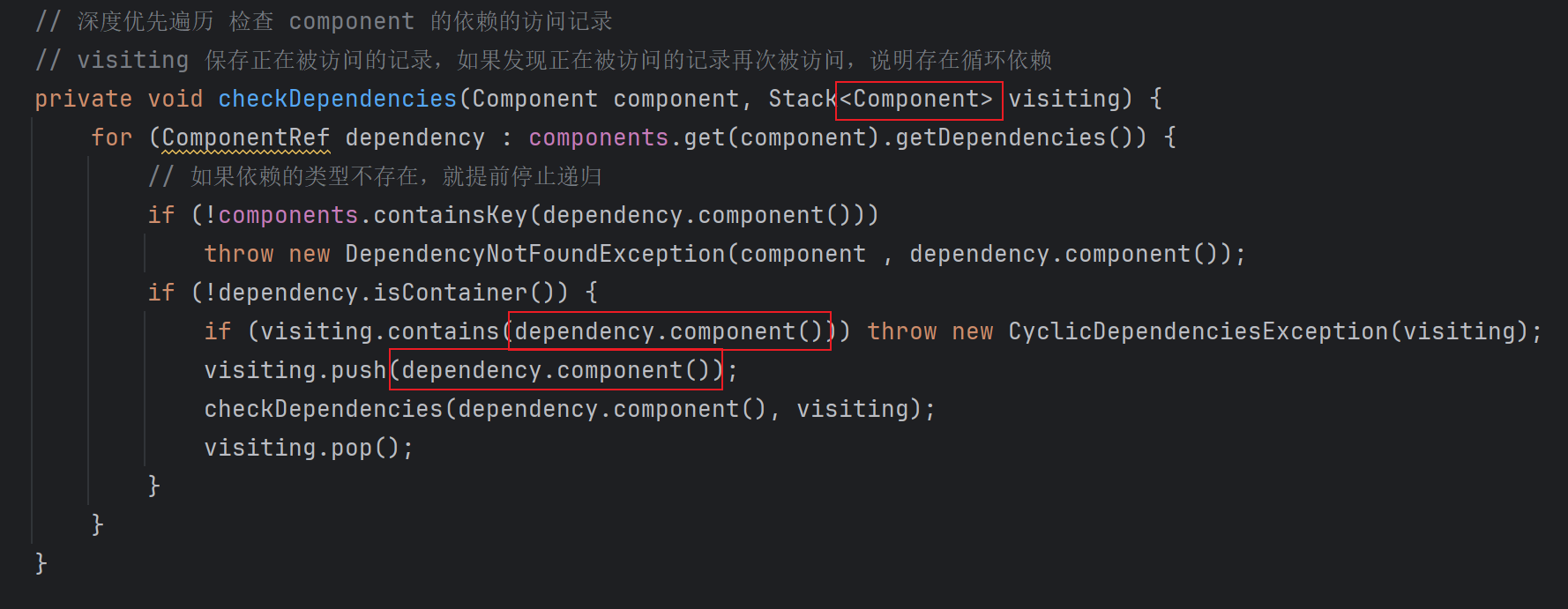
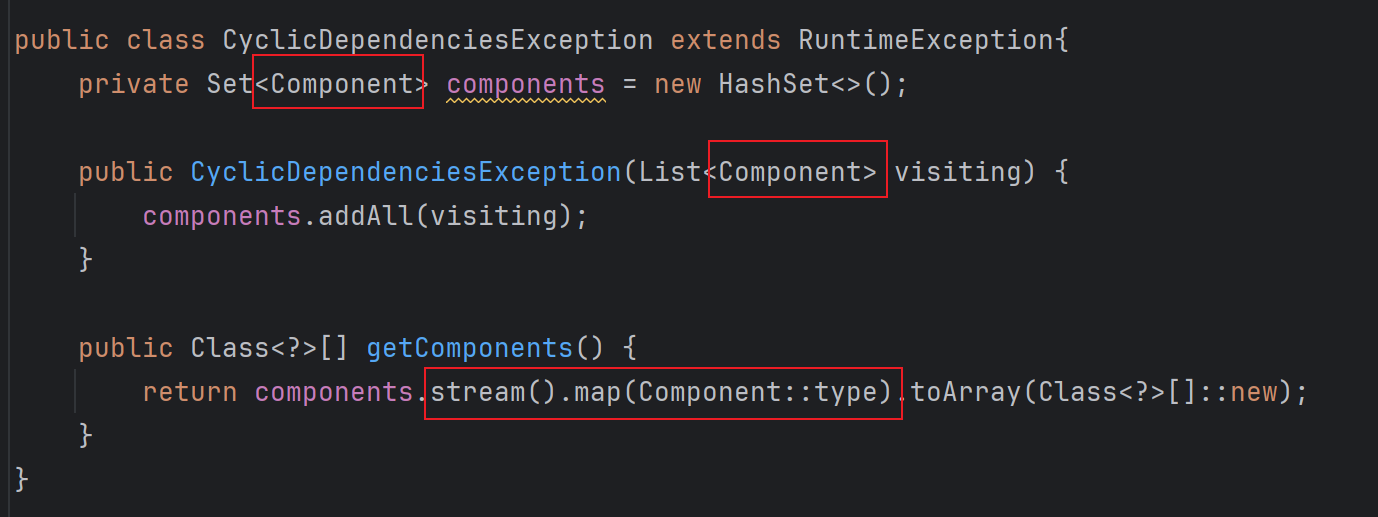
运行测试,通过。
ComponentProvider 检查 Qualifier 依赖
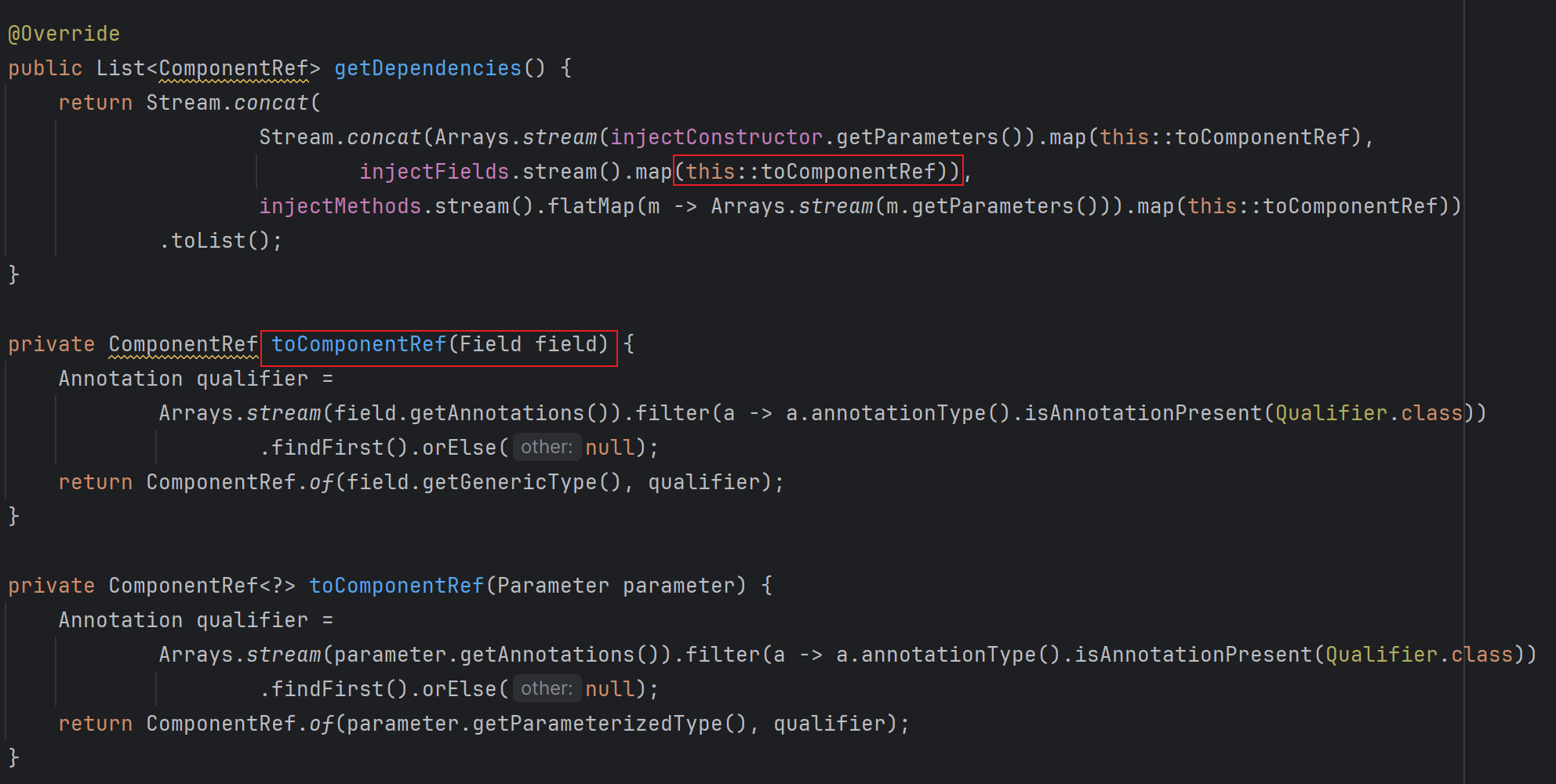
检查 getDependencies 获取依赖时,返回正确的依赖,前面已经完成了构造器注入 Qualifier 依赖的检查。还需要检查字段注入和方法注入 Qualifier 依赖时的检查。
这里先检查方法注入时的情况。
构造测试,位于 InjectionTest.MethodInjection.WithQualifier中:
1   // TODO include qualifier with dependency
2   static class InjectMethod {
3       @Inject
4       void install(@Named("ChosenOne") Dependency dependency) {
5
6       }
7   }
8   @Test
9   public void should_include_dependency_with_qualifier() {
10      InjectionProvider<InjectMethod> provider = new InjectionProvider<>(InjectMethod.class);
11
12      assertArrayEquals(new ComponentRef[]{ComponentRef.of(Dependency.class, new NamedLiteral("ChosenOne"))},
13              provider.getDependencies().toArray(ComponentRef[]::new));
14  }
实现:
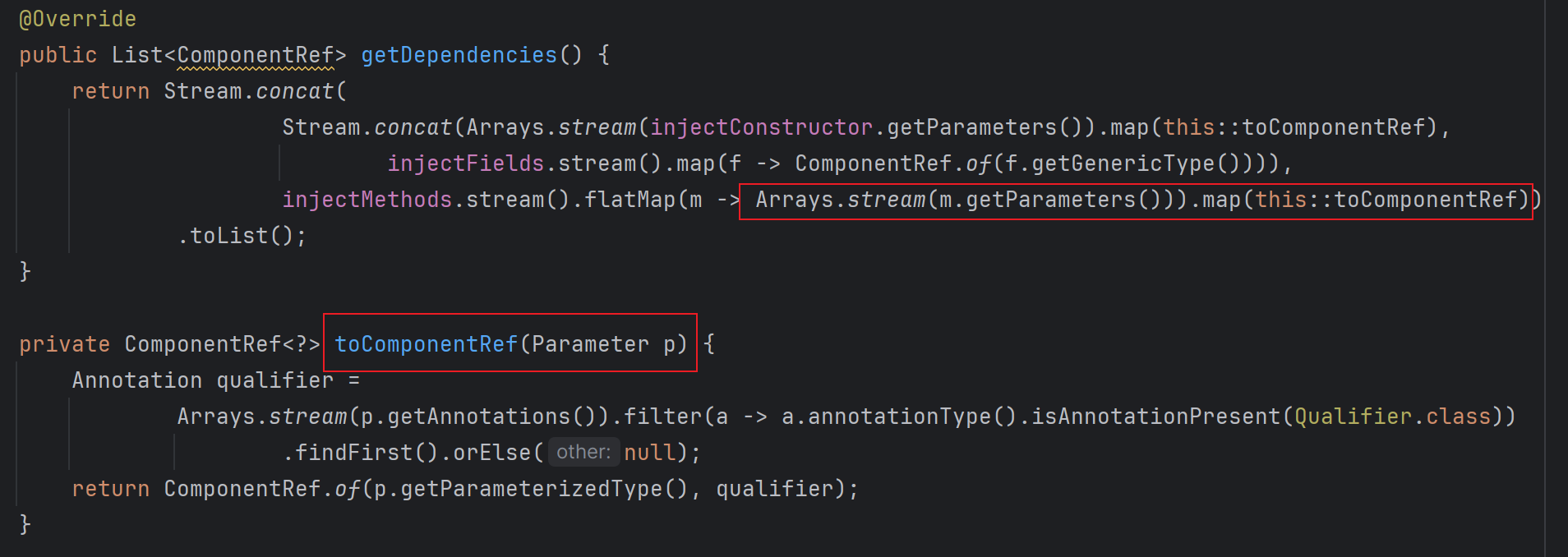
构造字段注入 Qualifier 依赖的测试:
1   // TODO include qualifier with dependency
2   static class InjectField {
3       @Inject
4       @Named("ChosenOne") Dependency dependency;
5   }
6   @Test
7   public void should_include_dependency_with_qualifier() {
8       InjectionProvider<InjectField> provider = new InjectionProvider<>(InjectField.class);
9
10      assertArrayEquals(new ComponentRef[]{ComponentRef.of(Dependency.class, new NamedLiteral("ChosenOne"))},
11              provider.getDependencies().toArray(ComponentRef[]::new));
12  }
实现:
inject with qualifier
实现注入被 Qualifier 标记的依赖的功能。
构造器注入被 Qualifier 标记的依赖
通过构造函数注入的方式,注入被 Qualifier 标记的组件,构造以下测试:
1   // TODO inject with qualifier
2   @Test
3   public void should_inject_dependency_with_qualifier_via_constructor() {
4       InjectionProvider<InjectConstructor> provider = new InjectionProvider<>(InjectConstructor.class);
5
6       InjectConstructor instance = provider.get(context);
7       assertSame(dependency, instance.dependency);
8   }
9
10  static class InjectConstructor {
11      Dependency dependency;
12      @Inject
13      public InjectConstructor(@Named("ChosenOne") Dependency dependency) {
14          this.dependency = dependency;
15      }
16  }
运行测试,测试会通过。
这是假阴性。
因为使用了测试替身,在测试替身构造的结果和生产代码都没发生改变的情况下,就不会出现错误。就会导致假阴性。
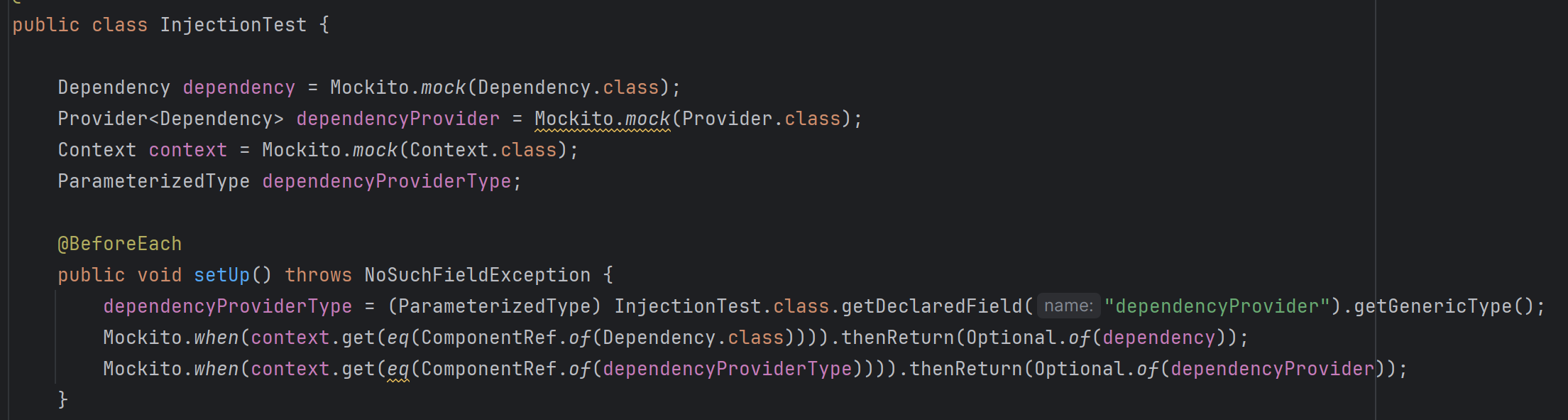
无法直接修改 setUp 中的行为,因为现在直接修改的话,会产生大量的错误。
需要在当前测试中,重置 sutUp 中的行为(预期),也就是重新设置测试夹具:
1   @Nested
2   class WithQualifier {
3
4       @BeforeEach
5       public void setUp() {
6           Mockito.reset(context);
7           Mockito.when(context.get(eq(ComponentRef.of(Dependency.class, new NamedLiteral("ChosenOne"))))).thenReturn(Optional.of(dependency));
8       }
9       // TODO inject with qualifier
10      @Test
11      public void should_inject_dependency_with_qualifier_via_constructor() {
12          InjectionProvider<InjectConstructor> provider = new InjectionProvider<>(InjectConstructor.class);
13
14          InjectConstructor instance = provider.get(context);
15          assertSame(dependency, instance.dependency);
16      }
17  }
此时运行测试,将不通过。
原因是,使用 get 方法获取组件时,会去容器中查找组件的依赖,并赋值到组件中。但是目前去容器中查找的方法,并没有携带 Qualifier 标记的信息,只包含了类型的信息。
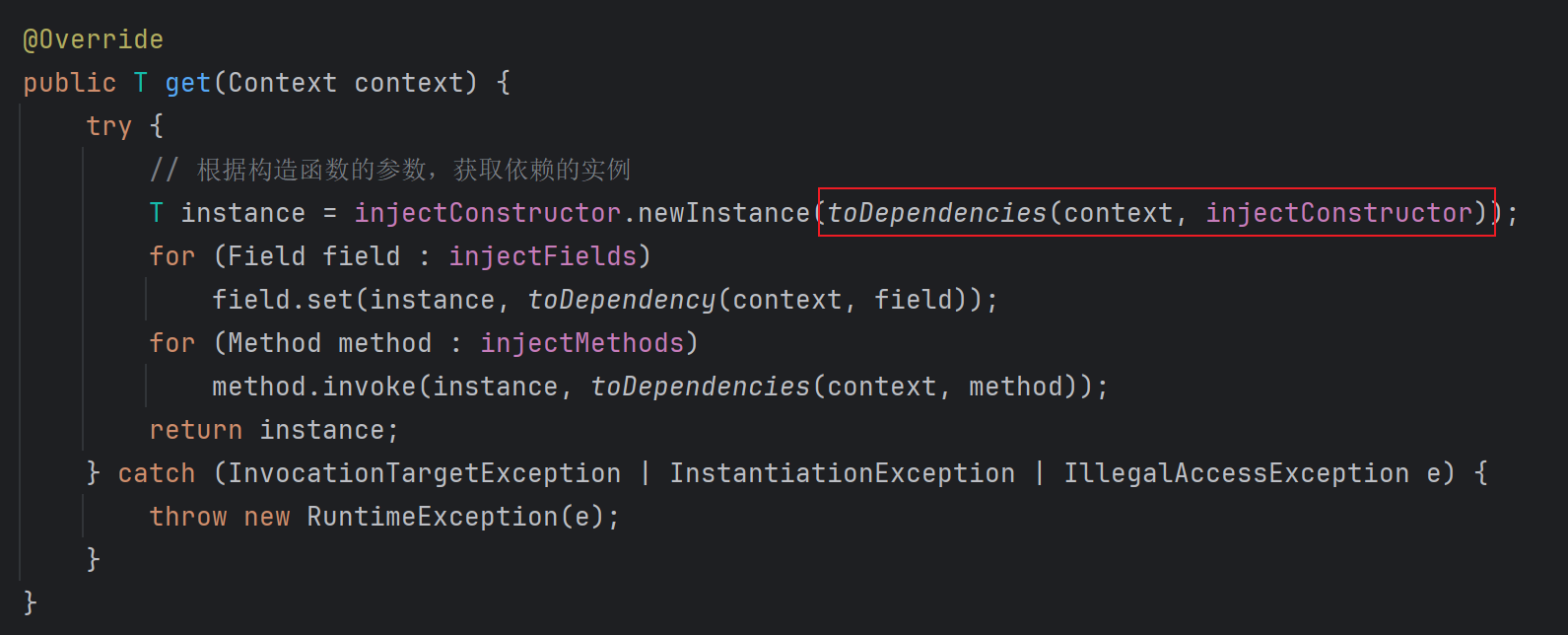

实现,即查找依赖时需要从容器中获取带有 qualifier
1 context.get(ComponentRef.of(type, qualifier))提取一个新方法,在其中获取参数的注解,并传递给 toDependency 方法。
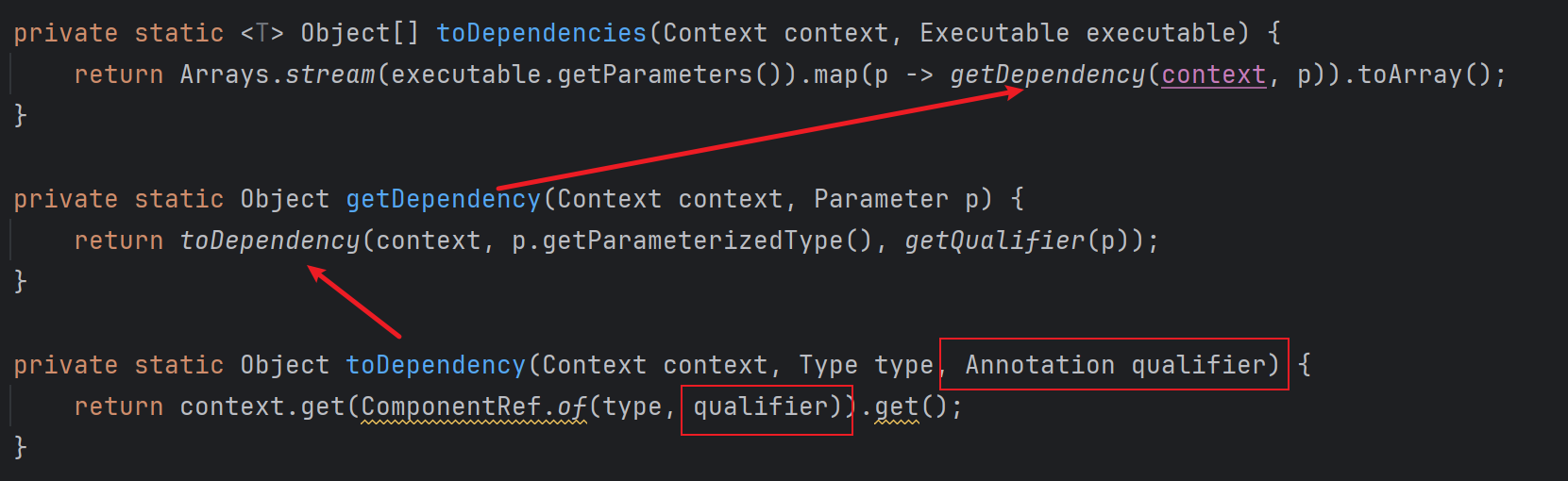
因为前面实现了一个获取方法参数的注解的功能,这里提取一个方法:
1   private static Annotation getQualifier(Parameter parameter) {
2           return Arrays.stream(parameter.getAnnotations()).filter(a -> a.annotationType().isAnnotationPresent(Qualifier.class))
3                   .findFirst().orElse(null);
4       }
运行测试,通过。
方法注入被 Qualifier 标记的依赖
通过构造函数注入的方式,注入被 Qualifier 标记的组件,构造以下测试:
1   @BeforeEach
2   public void setUp() {
3       Mockito.reset(context);
4       Mockito.when(context.get(eq(ComponentRef.of(Dependency.class, new NamedLiteral("ChosenOne"))))).thenReturn(Optional.of(dependency));
5   }
6
7   // inject with qualifier
8   @Test
9   public void should_inject_dependency_with_qualifier_via_method() {
10      InjectionProvider<InjectMethod> provider = new InjectionProvider<>(InjectMethod.class);
11
12      InjectMethod instance = provider.get(context);
13      assertSame(dependency, instance.dependency);
14  }
15
16  static class InjectMethod {
17      Dependency dependency;
18
19      @Inject
20      void install(@Named("ChosenOne") Dependency dependency) {
21          this.dependency = dependency;
22      }
23  }
运行测试,通过。因为方法注入和构造函数注入的内部实现是一样的,所以不需要修改生产代码。
字段注入被 Qualifier 标记的依赖
构造测试
1   @BeforeEach
2   public void setUp() {
3       Mockito.reset(context);
4       Mockito.when(context.get(eq(ComponentRef.of(Dependency.class, new NamedLiteral("ChosenOne"))))).thenReturn(Optional.of(dependency));
5   }
6
7   @Test
8   public void should_inject_dependency_with_qualifier_via_field() {
9       InjectionProvider<InjectField> provider = new InjectionProvider<>(InjectField.class);
10
11      InjectField instance = provider.get(context);
12      assertSame(dependency, instance.dependency);
13  }
同理需要修改 toDependency 的参数:
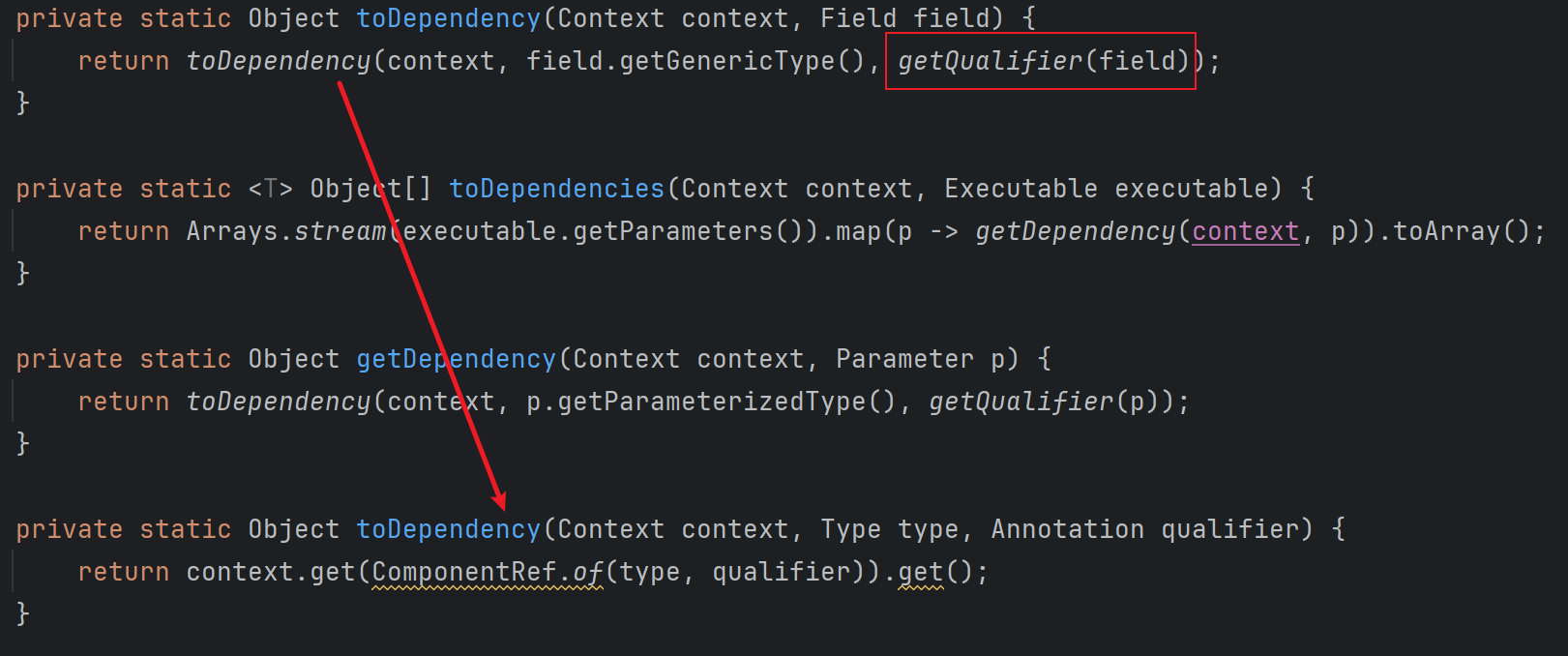
因为前面实现过获取 Field 中的注解的功能,这里提取一个方法。
1   private static Annotation getQualifier(Field field) {
2           return Arrays.stream(field.getAnnotations()).filter(a -> a.annotationType().isAnnotationPresent(Qualifier.class))
3                   .findFirst().orElse(null);
4       }
非法的 Qualifier 注入
非法注入的情况是指,同时使用两个 Qualifier 注解标注同一个依赖时的情况。
根据 JSR330 规范,同一个组件可以被多个 Qualifier 标记注册多个,但是依赖只能指定一个 Qualifier 注解。
构造器非法注入
构造测试:
1   // TODO throw illegal component if illegal qualifier given to injection point
2   static class MultiQualifierInjectConstructor {
3       @Inject
4       public MultiQualifierInjectConstructor(@Named("ChosenOne") @AnotherOne Dependency dependency) {
5       }
6   }
7   @Test
8   public void should_throw_exception_if_multi_qualifier_given_to_inject_constructor() {
9       // 需要在创建时检查依赖是否合法
10      assertThrows(IllegalComponentException.class,
11              () -> new InjectionProvider<>(MultiQualifierInjectConstructor.class));
12  }
运行测试,不通过,即不会抛出异常,我们需要的是抛出异常。
因为当前并没有在创建 InjectionProvider 时检查依赖是否合法,也没有去校验依赖被多个 Qualifier 标注的情况,目前只取其中一个 Qualifier 注解注册。
所以需要修改检查依赖的代码,并将检查依赖的代码加入到构造 Provider 时。
修改获取依赖参数上的 Qualifier 注解,判断注解的数量:
1   private static Annotation getQualifier(Parameter parameter) {
2       List<Annotation> qualifiers = Arrays.stream(parameter.getAnnotations())
3               .filter(a -> a.annotationType().isAnnotationPresent(Qualifier.class)).toList();
4       if (qualifiers.size() > 1) throw new IllegalComponentException();
5       return qualifiers.stream().findFirst().orElse(null);
6   }
并在构造函数中获取依赖(获取依赖时,会调用 getQualifier 方法,即会检查依赖上的 Qualifier 是否不合法)
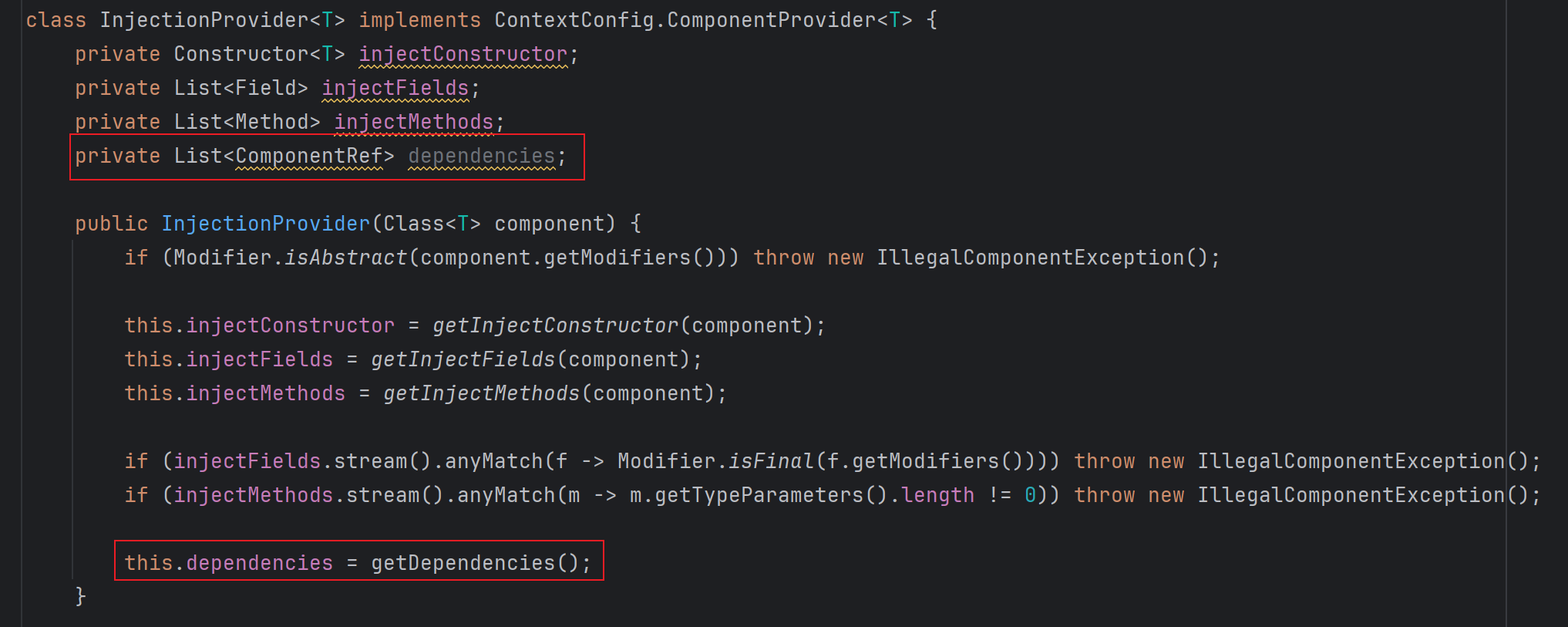
运行测试,通过。
方法非法注入
构造测试:
1   static class MultiQualifierInjectMethod {
2       Dependency dependency;
3       @Inject
4       public void install(@Named("ChosenOne") @AnotherOne Dependency dependency) {
5       }
6   }
7   @Test
8   public void should_throw_exception_if_multi_qualifier_given_to_inject_method() {
9       // 需要在创建时检查依赖是否合法
10      assertThrows(IllegalComponentException.class,
11              () -> new InjectionProvider<>(MultiQualifierInjectMethod.class));
12  }
运行测试,直接通过。因为方法注入的内部实现和构造器注入的内部实现一致,不需要修改生产代码。
字段非法注入
构造测试:
1   static class MultiQualifierInjectField {
2       @Inject
3       @Named("ChosenOne") @AnotherOne Dependency dependency;
4   }
5   @Test
6   public void should_throw_exception_if_multi_qualifier_given_to_inject_field() {
7       // 需要在创建时检查依赖是否合法
8       assertThrows(IllegalComponentException.class,
9               () -> new InjectionProvider<>(MultiQualifierInjectField.class));
10  }
同理,也需要修改 getQualifier 方法:
1   private static Annotation getQualifier(Field field) {
2       List<Annotation> qualifiers = Arrays.stream(field.getAnnotations())
3               .filter(a -> a.annotationType().isAnnotationPresent(Qualifier.class)).toList();
4       if (qualifiers.size() > 1) throw new IllegalComponentException();
5       return qualifiers.stream().findFirst().orElse(null);
6   }
运行测试,通过。
重构
合并两个 getQualifier
我们这里目前有两个内部实现完全一样的方法,分别是:getQualifier(Field field) 、getQualifier(Parameter parameter)
因为 Field 和 Parameter 实现了共同的 AnnotatedElement 接口,可以将这两个方法合并为一个。
1   private static Annotation getQualifier(AnnotatedElement parameter) {
2       List<Annotation> qualifiers = Arrays.stream(parameter.getAnnotations())
3               .filter(a -> a.annotationType().isAnnotationPresent(Qualifier.class)).toList();
4       if (qualifiers.size() > 1) throw new IllegalComponentException();
5       return qualifiers.stream().findFirst().orElse(null);
6   }
简化 toDependency 代码,减少调用层级
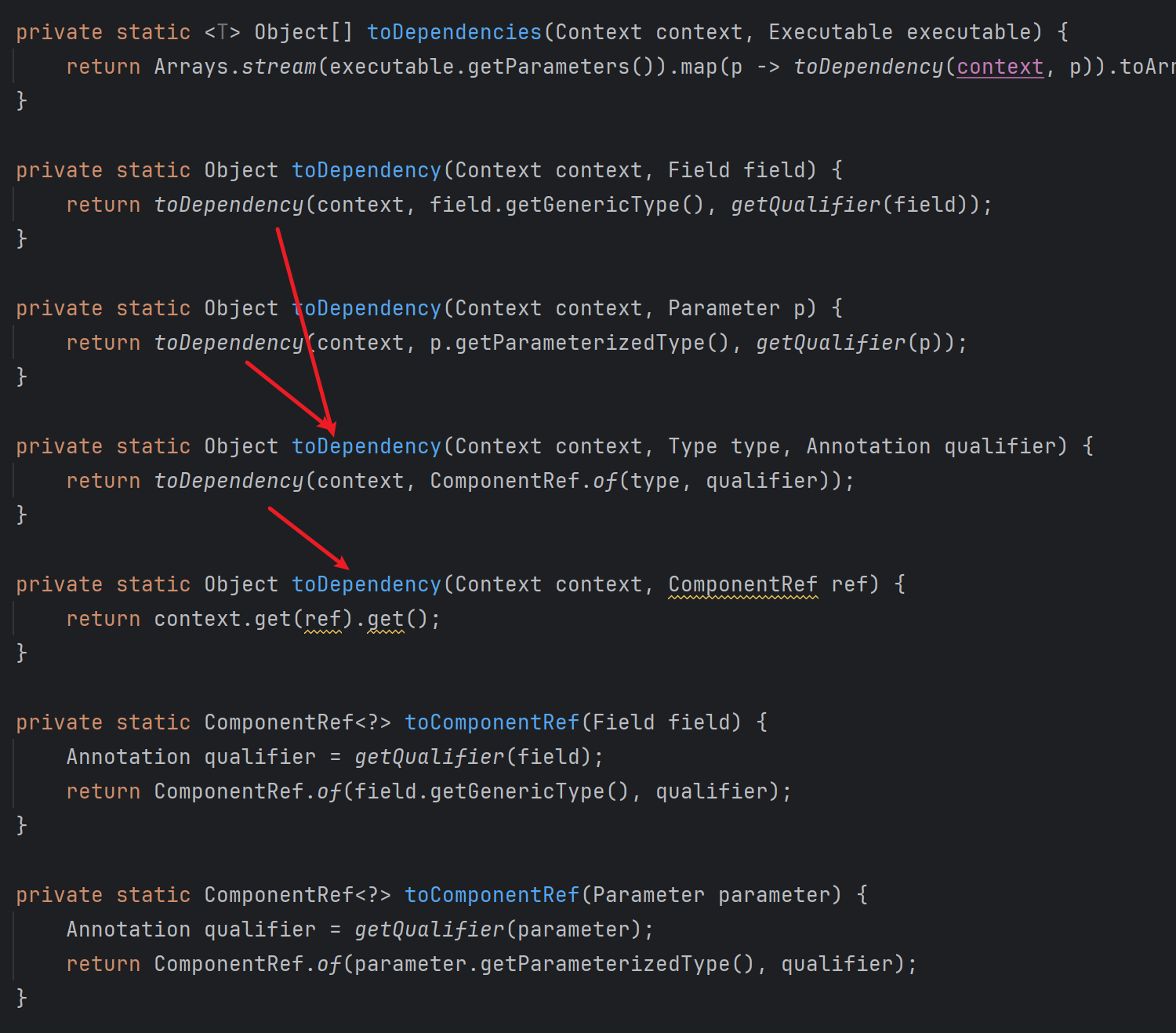
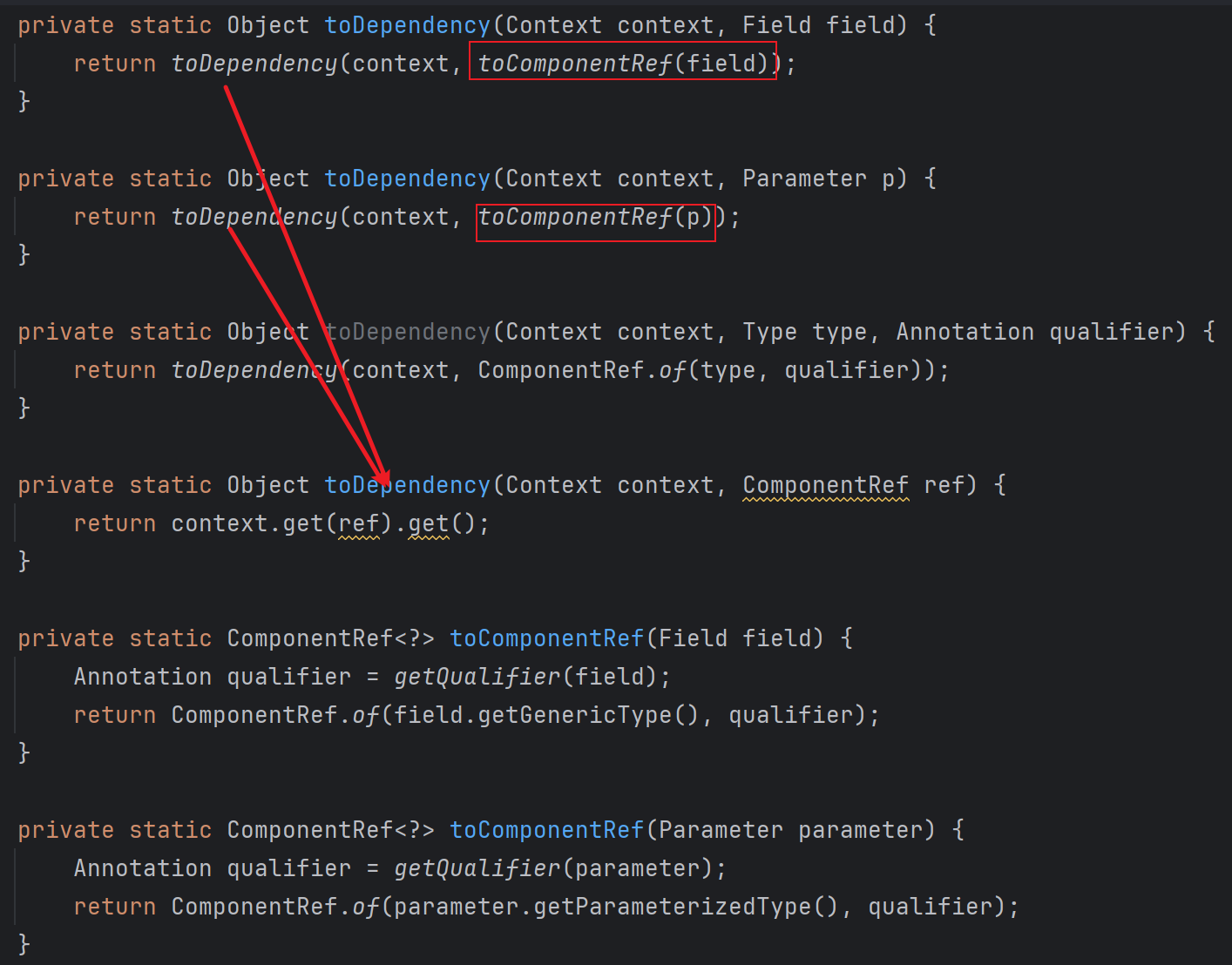
dependency 被获取了两次,属于重复
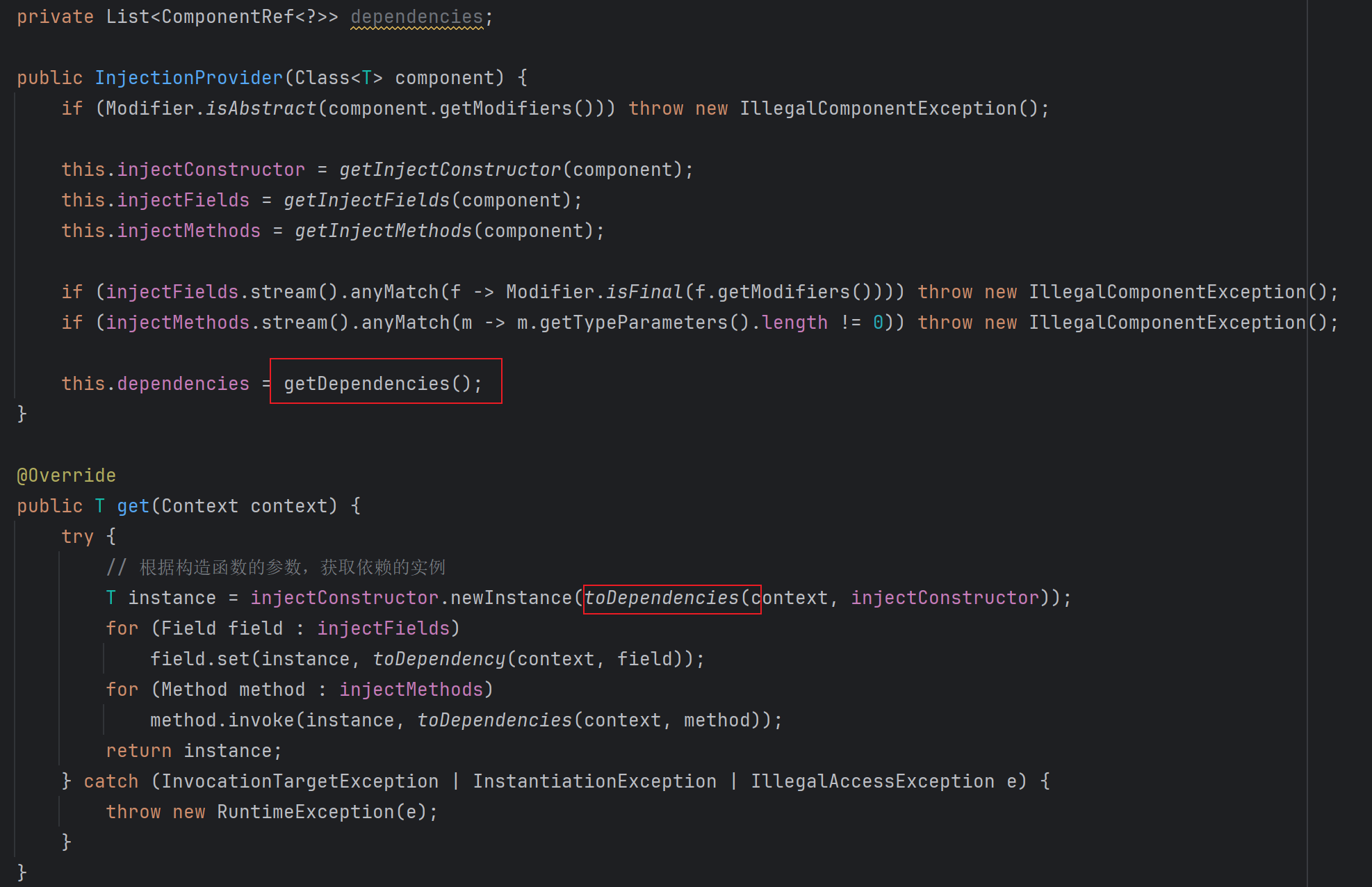
这是最难发现和消除的坏味道。这可能意味着我们对模型概念的封装不足。
模型封装
先创建一个封装类,将注入器和依赖组合在一起。
1   static record Injectable<Element extends AccessibleObject>(Element element, ComponentRef<?>[] required){
2
3   }
范型继承自 AccessibleObject,因为其子类正好包含当前需要的 Constructor、Field、Method,并使用 ComponentRef 数组表示依赖。
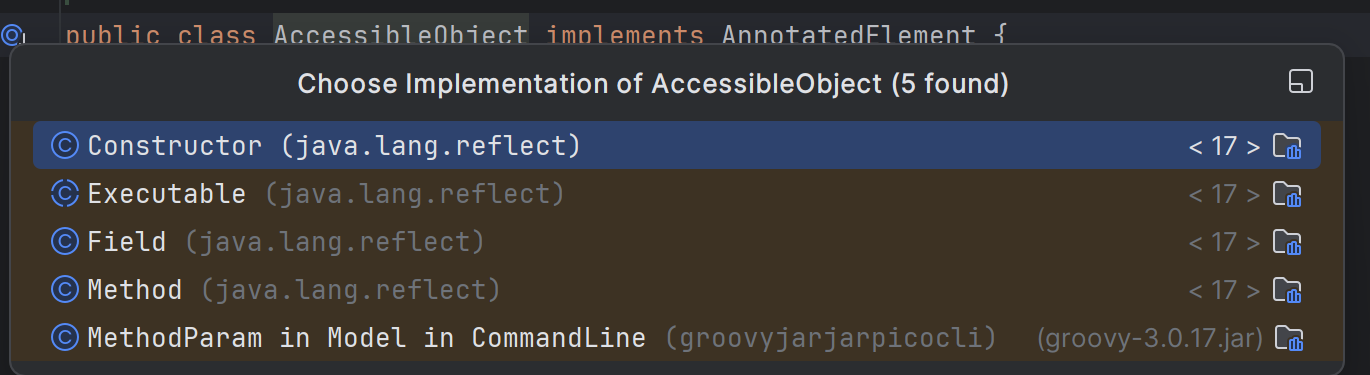
封装构造器和依赖
使用 injectableConstructor 来代替原有的 injectConstructor,同样是先新增功能再替换:
1   private Constructor<T> injectConstructor;
2   private Injectable<Constructor<T>> injectableConstructor;
new InjectionProvider 时,同时为 injectableConstructor 赋值,需要先获取 constructor 和 构造器依赖的 dependency,获取这两数据的代码,在现有的代码里面已经存在了,直接复用就可以。
1   Constructor<T> constructor = getInjectConstructor(component);
2   ComponentRef<?>[] constructorDependencies = Arrays.stream(constructor.getParameters()).map(InjectionProvider::toComponentRef)
3           .toArray(ComponentRef<?>[]::new);
4   this.injectableConstructor = new Injectable<>(constructor, constructorDependencies);
接着,需要找到 injectConstructor 在哪里使用,并使用 injectableConstructor 替换掉 injectConstructor。
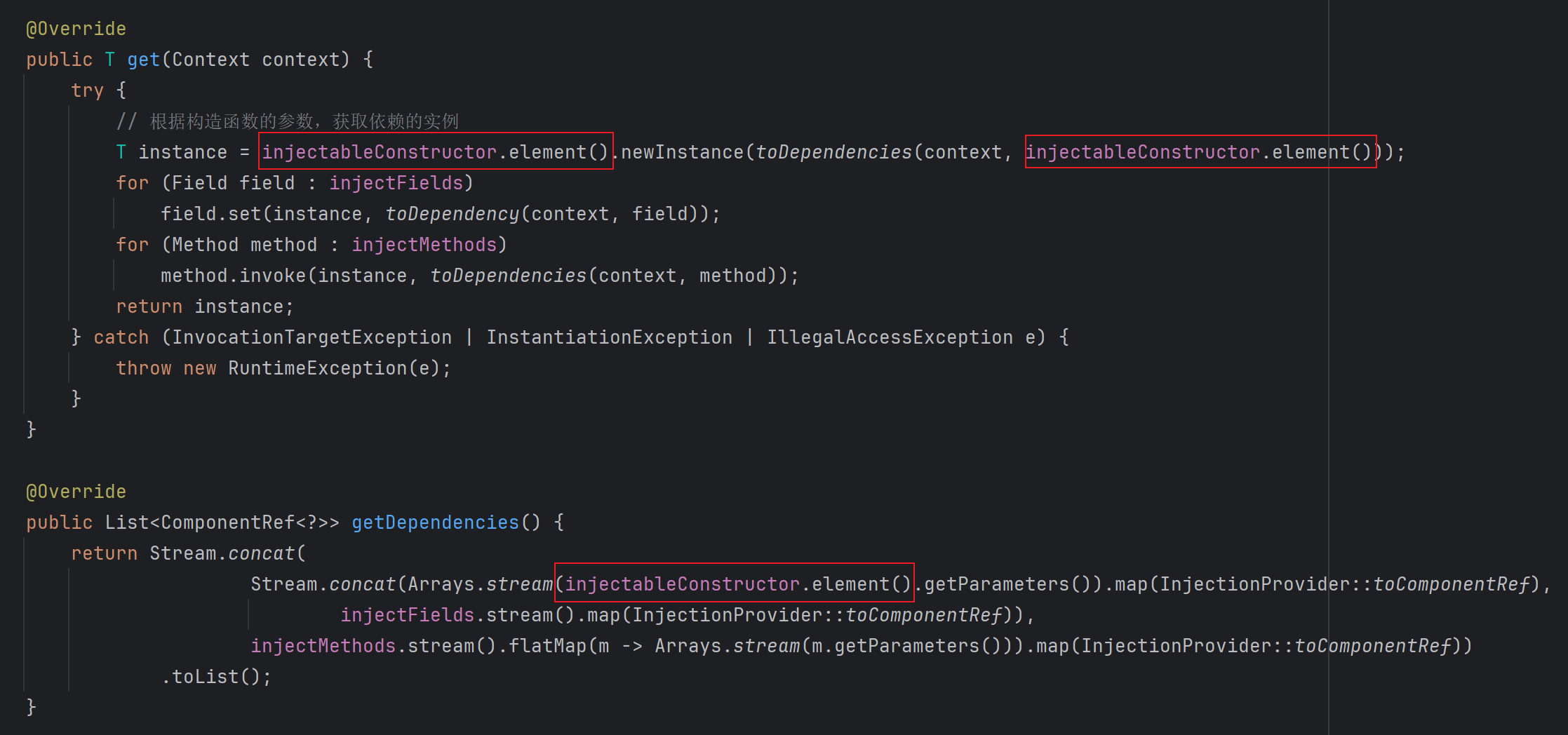
并且以上 getDependencies 方法中的部分还需要替换为如下,避免重复获取依赖,可以直接从 injectableConstructor 获取:

同样的,newInstance 也不需要重新获取依赖,可以直接从 injectable 中获取。
在 Injectable 中增加一个方法,直接从 context 容器中查找依赖,并返回为 newInstance 所需的数组。
1   static record Injectable<Element extends AccessibleObject>(Element element, ComponentRef<?>[] required){
2       Object[] toDependencies(Context context) {
3           return Arrays.stream(required).map(context::get).map(Optional::get).toArray();
4       }
5   }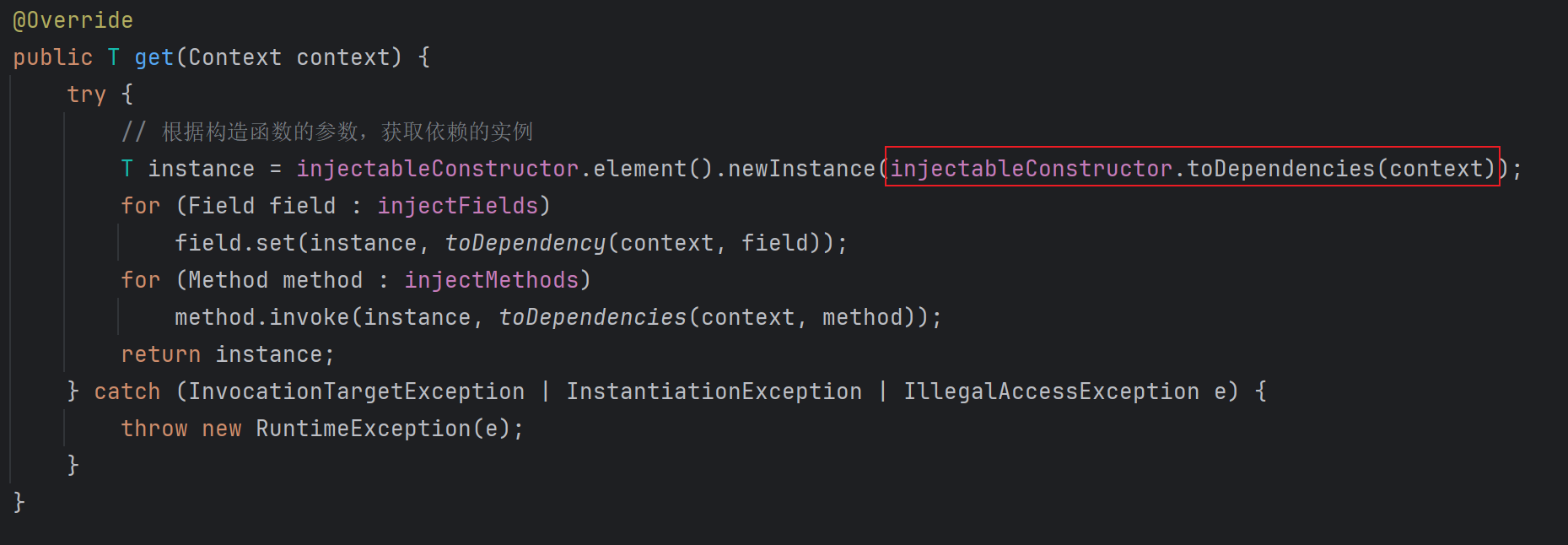
修改后,可以移除 injectConstructor。
再将 injectableConstructor 重名回 injectConstructor。
封装方法注入器和依赖
同样的,使用 injectableMethods 替换掉 injectMethods:
1   private List<Injectable<Method>> injectableMethods;
2   private List<Method> injectMethods;
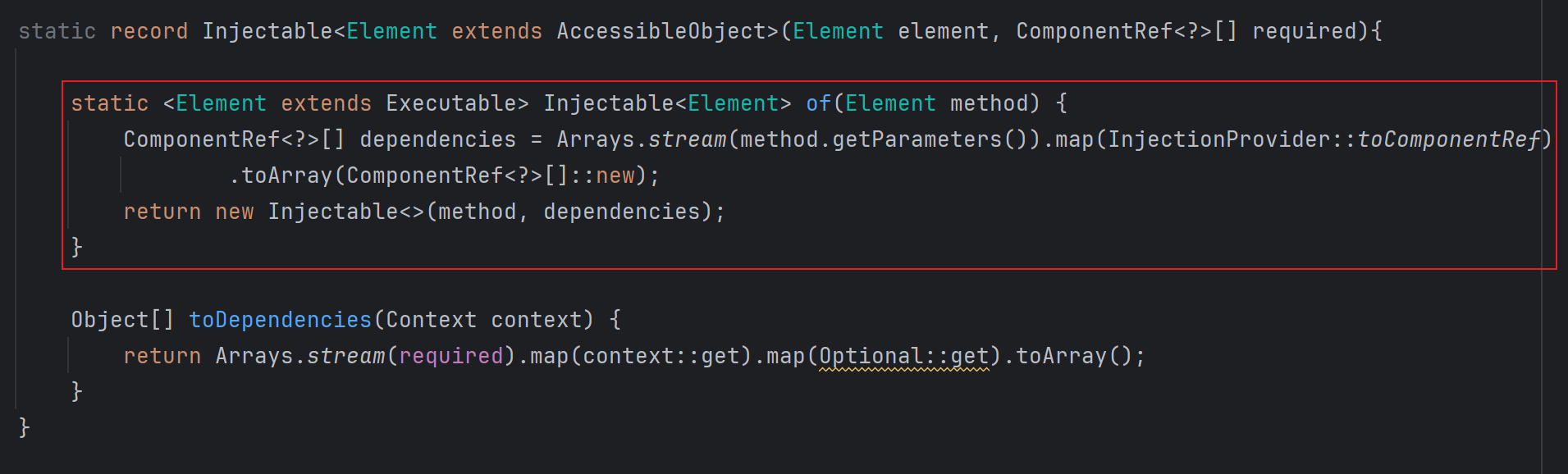
因为构造器和普通方法都是属于方法,并且因为 Constructor 和 Method 都有一个名为 Executable 的父类,所以将构造每一个 Executable 的 Injectable 的代码提取为一个方法,用于同时创建 Constructor 和 Method 的 Injectable 封装类:
1   private static <Element extends Executable> Injectable<Element> getInjectable(Element method) {
2       ComponentRef<?>[] dependencies = Arrays.stream(method.getParameters()).map(InjectionProvider::toComponentRef)
3               .toArray(ComponentRef<?>[]::new);
4       return new Injectable<>(method, dependencies);
5   }
那么 injectableMethods 的赋值语句就如下所示:
1 this.injectableMethods = getInjectMethods(component).stream().map(InjectionProvider::getInjectable).toList();接着找到,injectMethods 在哪里被使用
之前的代码有一处有问题的地方,这里应该先使用 injectMethods 替换掉,不然就在 new InjectionProvider 时,重复调用了两次 getInjectMethods 方法

修为为:

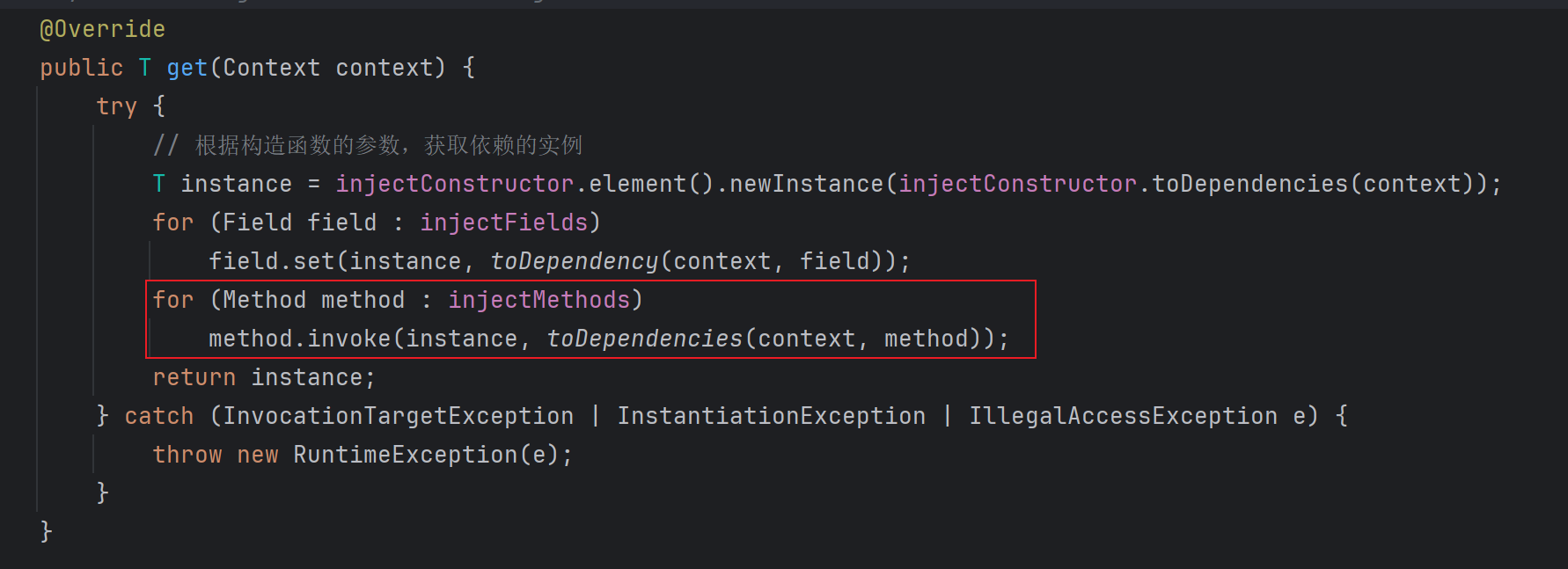
修改为:
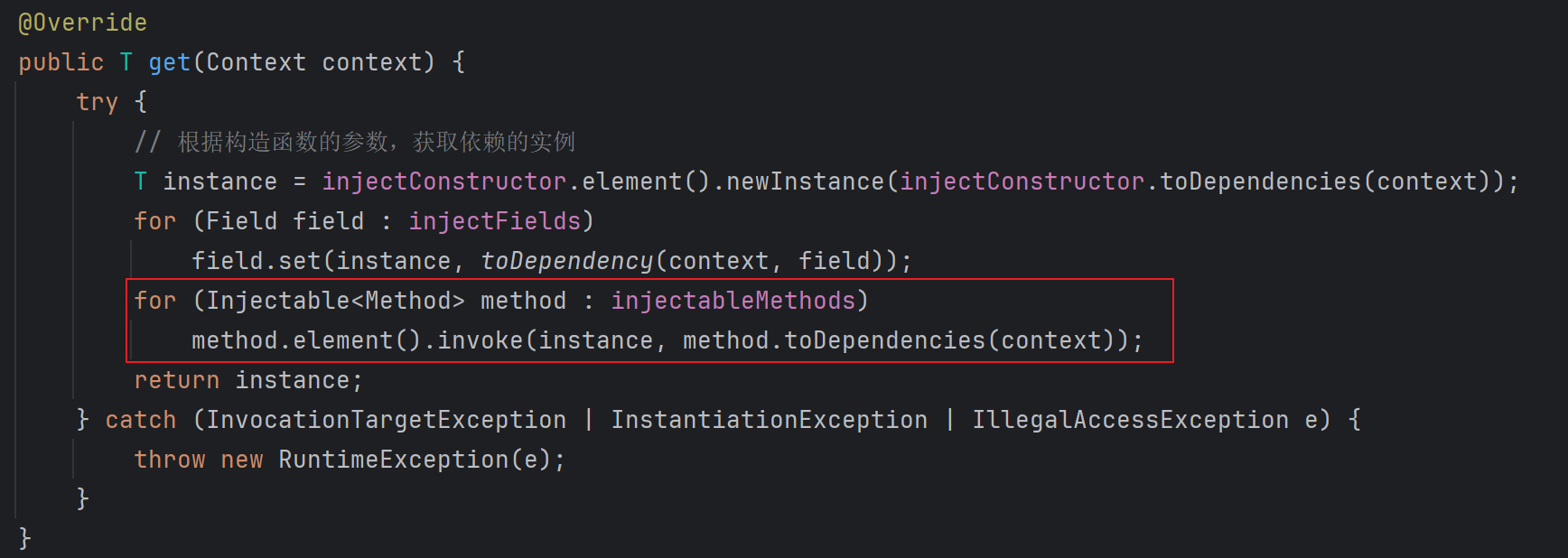

修改为:
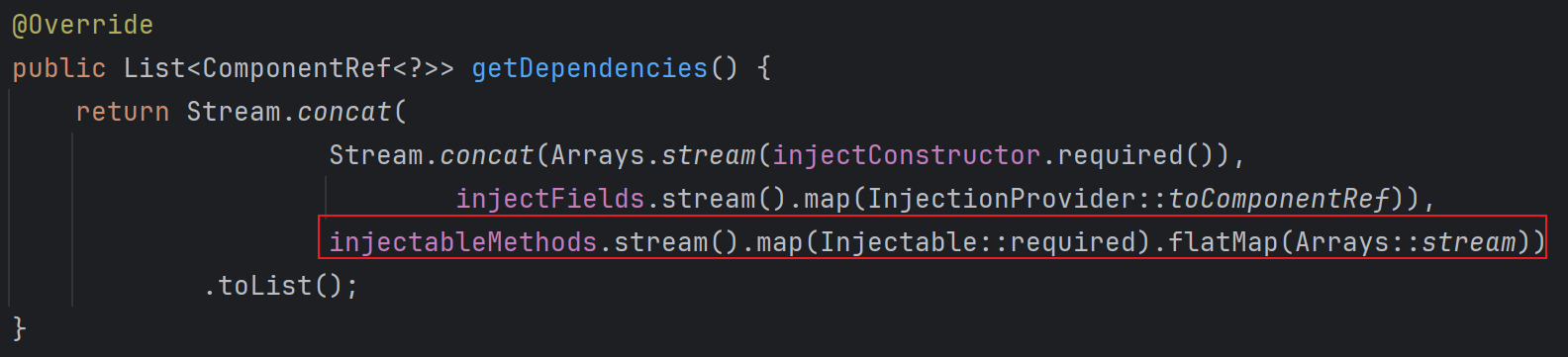
移除掉 injectMethods 字段
再将 injectableMethods 重命名回 injectMethods
简单重构
先将当前的 getInjectable 方法移动到 Injectable 中,并重命名为 of,这就是一个工厂方法:
封装字段注入器和依赖
使用 injectableFields 替换掉 injectFields
1   private List<Injectable<Field>> injectableFields;
2
3   private List<Field> injectFields;
在 Injectable 中新建一个工厂方法:
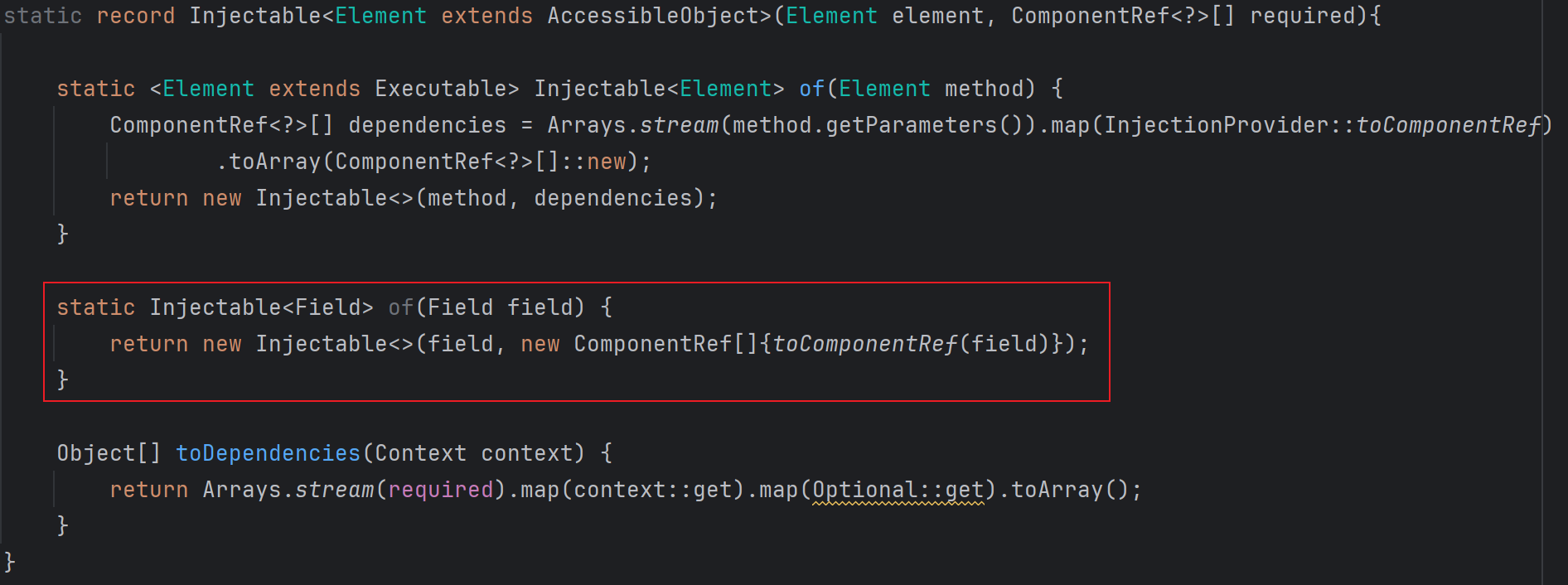
那么 injectableFields 的赋值语句为:
1 this.injectableFields = getInjectFields(component).stream().map(Injectable::of).toList();接着查找 injectFields 在哪里被使用,并修改为 injectableFields

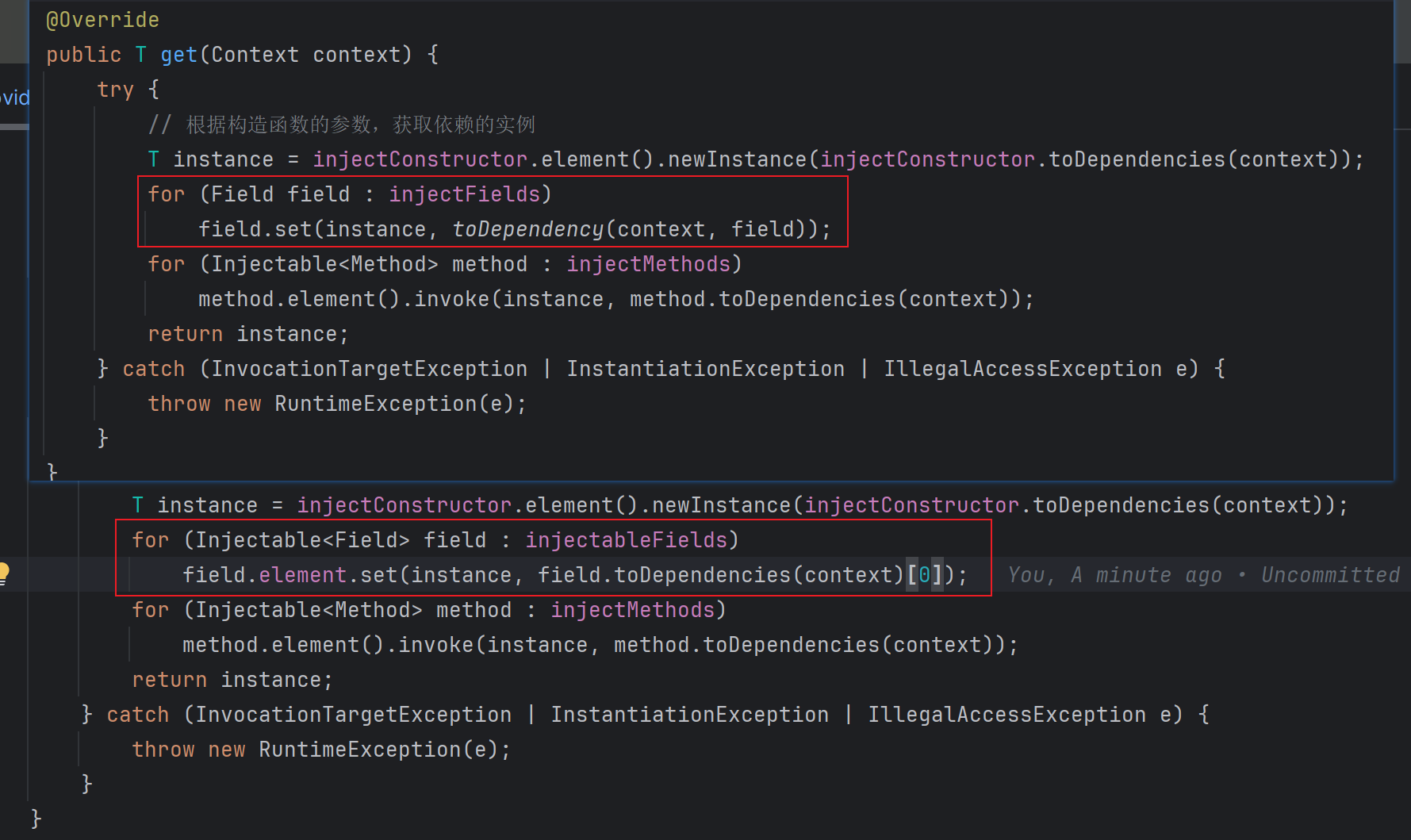
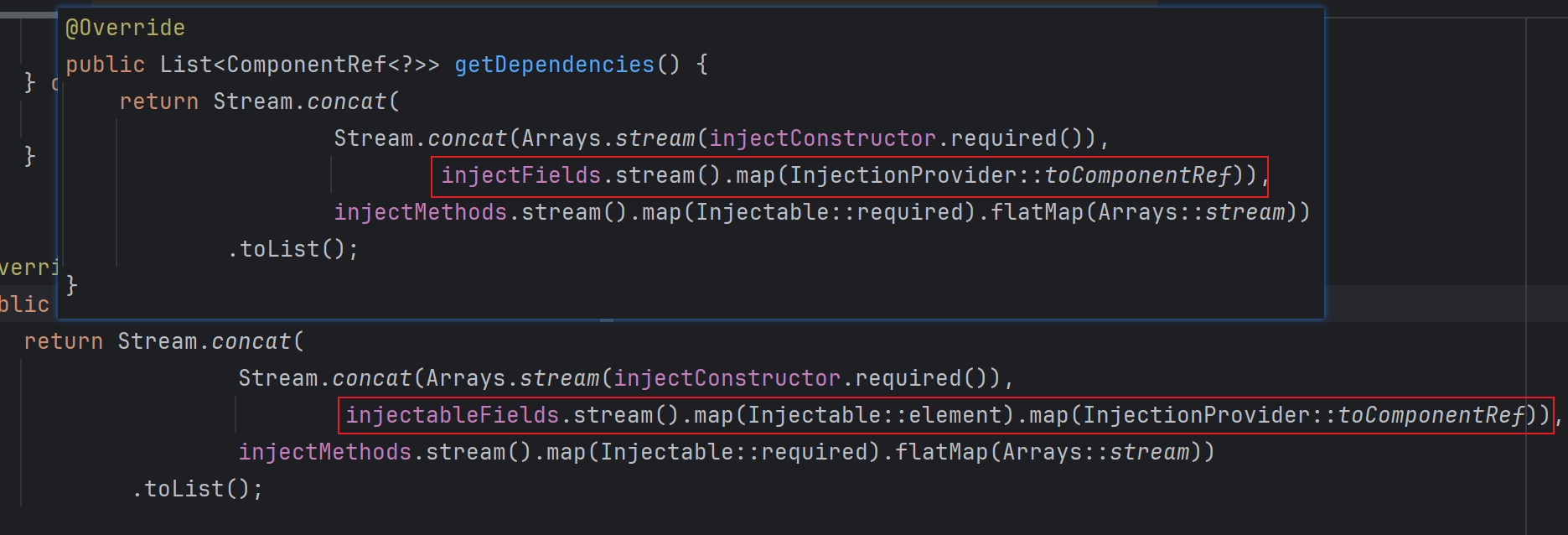
更好的实现是直接从 Injectable 中获取依赖,避免计算:
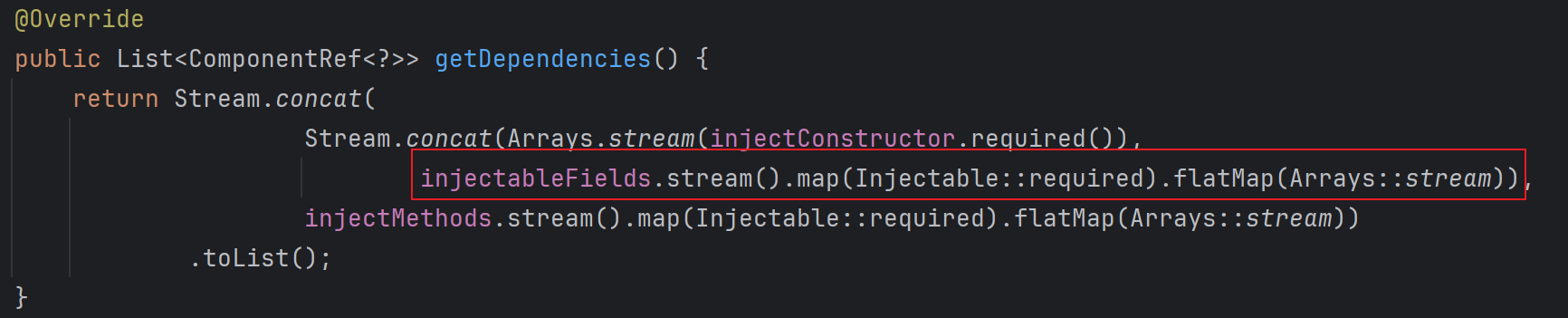
移除 injectFields 字段,
再将 injectableFields 重命名为 injectFields
至此,dependencies 字段已无用,也可以删除,并移除掉一些不再使用的方法。
那么,InjectionProvider 的字段和构造函数就变为:
1   private Injectable<Constructor<T>> injectConstructor;
2   private List<Injectable<Method>> injectMethods;
3   private List<Injectable<Field>> injectFields;
4
5   public InjectionProvider(Class<T> component) {
6       if (Modifier.isAbstract(component.getModifiers())) throw new IllegalComponentException();
7
8       Constructor<T> constructor = getInjectConstructor(component);
9       this.injectConstructor = Injectable.of(constructor);
10      this.injectMethods = getInjectMethods(component).stream().map(Injectable::of).toList();
11      this.injectFields = getInjectFields(component).stream().map(Injectable::of).toList();
12
13      if (injectFields.stream().map(Injectable::element).anyMatch(f -> Modifier.isFinal(f.getModifiers())))
14          throw new IllegalComponentException();
15      if (injectMethods.stream().map(Injectable::element).anyMatch(m -> m.getTypeParameters().length != 0))
16          throw new IllegalComponentException();
17
18  }
整理代码
观察发现,这几个方法只会在 Injectable 中被调用,可以将这几个方法移动到 Injectable 中
1   private static ComponentRef<?> toComponentRef(Field field) {
2       Annotation qualifier = getQualifier(field);
3       return ComponentRef.of(field.getGenericType(), qualifier);
4   }
5
6   private static ComponentRef<?> toComponentRef(Parameter parameter) {
7       Annotation qualifier = getQualifier(parameter);
8       return ComponentRef.of(parameter.getParameterizedType(), qualifier);
9   }
10
11  private static Annotation getQualifier(AnnotatedElement parameter) {
12      List<Annotation> qualifiers = Arrays.stream(parameter.getAnnotations())
13              .filter(a -> a.annotationType().isAnnotationPresent(Qualifier.class)).toList();
14      if (qualifiers.size() > 1) throw new IllegalComponentException();
15      return qualifiers.stream().findFirst().orElse(null);
16  }
可以使用 Move Member 的重构方式移动:
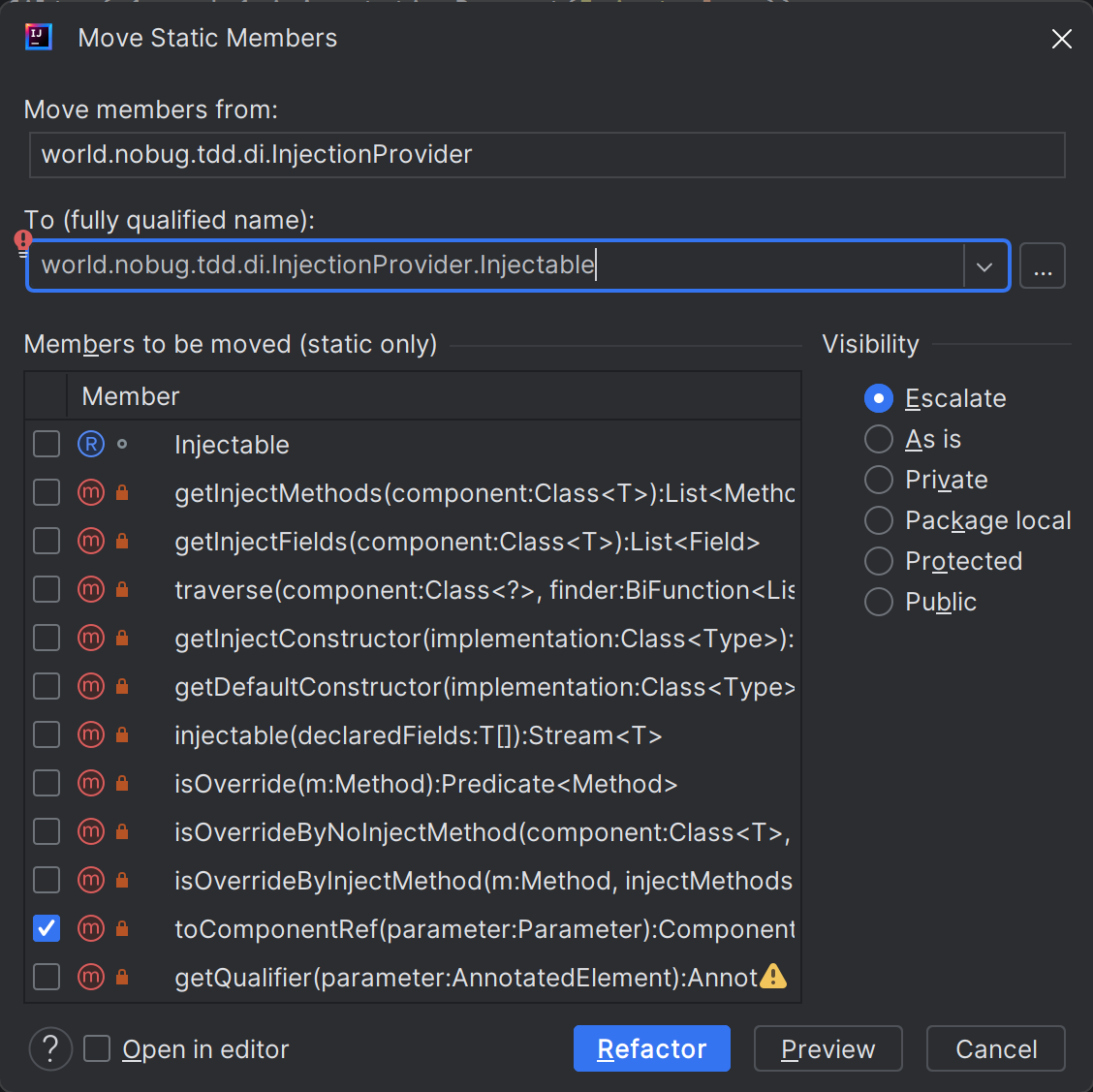
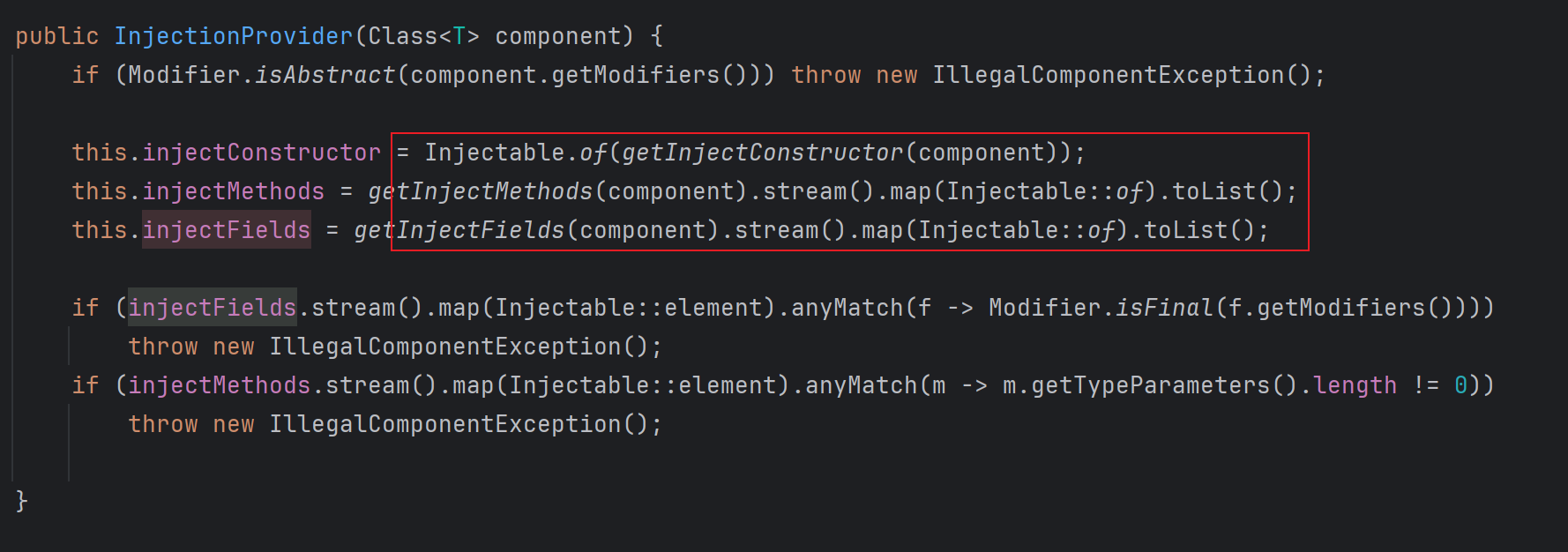
将这些表达式都提取为方法:

将getDependencies 方法:
1   @Override
2   public List<ComponentRef<?>> getDependencies() {
3       return Stream.concat(
4                       Stream.concat(Arrays.stream(injectConstructor.required()),
5                               injectFields.stream().map(Injectable::required).flatMap(Arrays::stream)),
6                       injectMethods.stream().map(Injectable::required).flatMap(Arrays::stream))
7               .toList();
8   }
简化为,先拼接为 Injectable 的 Stream,再 Map
1   @Override
2   public List<ComponentRef<?>> getDependencies() {
3       return Stream.concat(Stream.concat(Stream.of(injectConstructor), injectFields.stream()), injectMethods.stream())
4               .flatMap(i -> Arrays.stream(i.required)).toList();
5   }
测试文档化重组
Provider 和 Qualifier 的测试
在 ContextText.TypeBinding.WithQualifier 中增加 Provider 和 Qualifier 相关联的两个测试,用于检查
- 获取被 Qualifier 的组件的 Provider
- 获取无对应 Qualifier 标记的组件的Provider是,Provider 应为空
1   @Test
2   public void should_retrieve_bind_type_as_provider() {
3       TestComponent component = new TestComponent() {
4       };
5       config.bind(TestComponent.class, component, new NamedLiteral("ChosenOne"), new AnotherOneLiteral());
6       Context context = config.getContext();
7       Optional<Provider<TestComponent>> provider =
8               context.get(new ComponentRef<Provider<TestComponent>>(new AnotherOneLiteral()) {});
9
10      assertTrue(provider.isPresent());
11  }
12
13  @Test
14  public void should_retrieve_empty_if_no_matched_qualifier() {
15      TestComponent component = new TestComponent() {
16      };
17      config.bind(TestComponent.class, component);
18      Context context = config.getContext();
19      Optional<Provider<TestComponent>> provider =
20              context.get(new ComponentRef<Provider<TestComponent>>(new NamedLiteral("ChosenOne")) {});
21
22      assertTrue(provider.isEmpty());
23  }
需要在 ComponentRef 中增加构造方法:
1   public ComponentRef(Annotation qualifier) {
2       Type type = ((ParameterizedType) (getClass().getGenericSuperclass())).getActualTypeArguments()[0];
3       init(type, qualifier);
4   }
Qualifier 依赖检查参数化
将当前 ContextText.DependencyCheck.WithQualifier 中两个测试修改为参数化的测试:
未找到被 Qualifier 标记的依赖时,抛出依赖不存在的异常的的参数化测试:
1   // dependency missing if qualifier not match
2   @ParameterizedTest
3   @MethodSource
4   public void should_throw_exception_if_dependency_with_qualifier_not_found(Class<? extends TestComponent> componentType) {
5
6       config.bind(Dependency.class, new Dependency() {
7       });
8       config.bind(TestComponent.class, componentType, new NamedLiteral("ChosenOne"));
9
10      DependencyNotFoundException exception =
11              assertThrows(DependencyNotFoundException.class, () -> config.getContext());
12
13      assertEquals(new Component(TestComponent.class, new NamedLiteral("ChosenOne")), exception.getComponent());
14      assertEquals(new Component(Dependency.class, new AnotherOneLiteral()), exception.getDependency());
15
16  }
17  public static Stream<Arguments> should_throw_exception_if_dependency_with_qualifier_not_found() {
18      return Stream.of(
19              Arguments.of(Named.of("Constructor Injection with Qualifier", DependencyCheck.WithQualifier.InjectConstructor.class)),
20              Arguments.of(Named.of("Field Injection with Qualifier", DependencyCheck.WithQualifier.InjectField.class)),
21              Arguments.of(Named.of("Method Injection with Qualifier", DependencyCheck.WithQualifier.InjectMethod.class)),
22              Arguments.of(Named.of("Provider Constructor Injection with Qualifier", DependencyCheck.WithQualifier.InjectConstructorProvider.class)),
23              Arguments.of(Named.of("Provider Field Injection with Qualifier", DependencyCheck.WithQualifier.InjectFieldProvider.class)),
24              Arguments.of(Named.of("Provider Method Injection with Qualifier", DependencyCheck.WithQualifier.InjectMethodProvider.class))
25      );
26  }
27
28  static class InjectConstructor implements TestComponent {
29      @Inject
30      public InjectConstructor(@AnotherOne Dependency dependency) {
31      }
32  }
33
34  static class InjectField implements TestComponent {
35      @Inject
36      @AnotherOne Dependency dependency;
37  }
38  static class InjectMethod implements TestComponent {
39      Dependency dependency;
40
41      @Inject
42      public void install(@AnotherOne Dependency dependency) {
43          this.dependency = dependency;
44      }
45  }
46
47  static class InjectConstructorProvider implements TestComponent {
48      @Inject
49      public InjectConstructorProvider(@AnotherOne Provider<Dependency> dependency) {
50      }
51  }
52
53  static class InjectFieldProvider implements TestComponent {
54      @Inject
55      @AnotherOne
56      Provider<Dependency> dependency;
57  }
58
59  static class InjectMethodProvider implements TestComponent {
60      Dependency dependency;
61
62      @Inject
63      public void install(@AnotherOne Provider<Dependency> dependency) {
64          this.dependency = dependency.get();
65      }
66  }
包含 Qualifier 标注的依赖的循环依赖检查的参数化测试:
1   // check cyclic dependencies with qualifier
2   // A -> @AnotherOne A -> @Named A
3   @ParameterizedTest(name = "{1} -> @AnotherOne({0}) -> @Named(\"ChosenOne\") not cyclic dependencies")
4   @MethodSource
5   public void should_not_throw_exception_if_component_with_same_type_tagged_with_different_qualifier(Class<? extends Dependency> anotherDependencyType,
6                                                                                                  Class<? extends Dependency> notCyclicDependencyType) {
7       Dependency instance = new Dependency() {
8       };
9       config.bind(Dependency.class, instance, new NamedLiteral("ChosenOne"));
10      config.bind(Dependency.class, anotherDependencyType, new AnotherOneLiteral());
11      config.bind(Dependency.class, notCyclicDependencyType);
12
13      assertDoesNotThrow(() -> config.getContext());
14  }
15
16  public static Stream<Arguments> should_not_throw_exception_if_component_with_same_type_tagged_with_different_qualifier() {
17      List<Arguments> arguments = new ArrayList<>();
18      for (Named anotherDependency : List.of(Named.of("Constructor Injection", AnotherOneDependencyConstructor.class),
19              Named.of("Field Injection", DependencyCheck.WithQualifier.AnotherOneDependencyField.class),
20              Named.of("Method Injection", DependencyCheck.WithQualifier.AnotherOneDependencyMethod.class))) {
21          for (Named notCyclicDependency : List.of(Named.of("Constructor Injection", NotCyclicDependencyConstructor.class),
22                  Named.of("Field Injection", DependencyCheck.WithQualifier.NotCyclicDependencyField.class),
23                  Named.of("Method Injection", DependencyCheck.WithQualifier.NotCyclicDependencyMethod.class))) {
24              arguments.add(Arguments.of(anotherDependency, notCyclicDependency));
25          }
26      }
27      return arguments.stream();
28  }
29
30  static class AnotherOneDependencyConstructor implements Dependency {
31      @Inject
32      public AnotherOneDependencyConstructor(@jakarta.inject.Named("ChosenOne") Dependency dependency) {
33      }
34  }
35  static class AnotherOneDependencyField implements Dependency {
36      @Inject
37      @jakarta.inject.Named("ChosenOne") Dependency dependency;
38
39  }
40  static class AnotherOneDependencyMethod implements Dependency {
41      @Inject
42      public void install(@jakarta.inject.Named("ChosenOne") Dependency dependency) {
43      }
44  }
45
46  static class NotCyclicDependencyConstructor implements Dependency {
47      @Inject
48      public NotCyclicDependencyConstructor(@AnotherOne Dependency dependency) {
49      }
50  }
51  static class NotCyclicDependencyField implements Dependency {
52      @Inject
53      @AnotherOne Dependency dependency;
54  }
55  static class NotCyclicDependencyMethod implements Dependency {
56      @Inject
57      public void install(@AnotherOne Dependency dependency) {
58      }
59  }